

Key takeaways
- Compare helical head jointers for cabinet work by width, insert count and motor, from benchtop spiral models to an 8-inch parallelogram floor machine.
A cabinet maker choosing a helical head jointer is really deciding how much tear-out insurance to buy. Figured maple door rails, cherry with reversing grain and glued-up panel stock all punish a straight-knife head, and every nick in a knife prints a raised line down the whole board. The real decision is which width and bed length your daily stock demands, because the insert head itself is the easy part: small carbide squares shear the wood instead of chopping it, and a damaged edge is fixed by rotating one insert rather than resetting three long knives.
This guide is for cabinet shops flattening face frames, door parts and panel glue-ups, whether that means a dedicated floor machine or a benchtop unit in a two-car garage. Every pick below is a jointer whose own Amazon listing states a helical or spiral cutterhead with indexable carbide inserts, and the specifications are taken from those listings, including cutting width, insert count and motor rating.
Quick Picks
As an Amazon Associate we earn from qualifying purchases
| Product | Best for | Key spec from title |
|---|---|---|
| Powermatic PJ-882HH | A production cabinet shop’s main jointer | 8-inch helical cutterhead, 2 HP, 230V |
| JET JJ-6HHDX | Smaller shops jointing mostly narrow stock | 6-inch long bed jointer, helical cutterhead, 1 HP |
| JET JJP-12HH | Wide boards plus thicknessing in one footprint | 12-inch planer/jointer, helical head, 3 HP |
| Wahuda 8-Inch Benchtop Jointer | Benchtop capacity without a floor machine | 8-inch spiral cutterhead, 10-amp motor |
| Cutech 401120HI-IF | Face jointing wide panels on a bench | 12-inch spiral cutterhead, 24 carbide inserts |
How to Choose
Start With the Width Your Stock Actually Needs
Cabinet work splits neatly by width. Face frames, stiles, rails and drawer parts rarely exceed six inches, so a 6-inch head covers them with room to angle the board slightly across the knives. The moment you face-joint door panels, wide drawer sides or one-piece cabinet sides, six inches forces awkward workarounds, and eight or twelve inches of width stops being a luxury. Measure the widest board you flattened in the last month, not the widest you can imagine, and buy for that board plus a small margin.
Count Inserts and Check How Many Edges Each One Has
The insert layout decides both finish quality and running cost. More inserts in more spiral rows means each cut is a smaller shearing bite, which is what keeps figured grain from tearing. Just as important is how many usable edges each insert carries: four-sided inserts rotate three more times after the first edge dulls, while two-sided inserts give you one rotation. A nick from a hidden staple or grit costs one insert either way, but a head with four-sided inserts spreads that cost across far more cutting life before you buy replacements.
Match the Motor and Voltage to Your Shop Wiring
Benchtop spiral jointers run universal motors rated in amps on a normal 120-volt circuit, which suits garages and small shops but limits how aggressive a full-width cut can be. Floor jointers move to induction motors rated in horsepower, and the stronger ones need a 230-volt circuit. Before falling for a 2 or 3 HP machine, confirm your panel can feed it and budget for the circuit if it cannot. A jointer that trips a breaker mid-pass leaves a worse surface than a smaller machine that never strains.
Weigh Bed Length and Fence Quality, Not Just the Head
The helical head gets the attention, but flatness comes from the beds. Longer tables support a bowed board so the head removes the high spots instead of following the curve, which matters on the long rails and cabinet sides this trade runs daily. Parallelogram beds keep the tables parallel to the head as depth changes. The fence deserves the same scrutiny: it should lock square without drifting and hold positive stops at 90 and 45 degrees, because a fence that creeps turns every edge joint into a glue-line gap.
The 5 Best Options
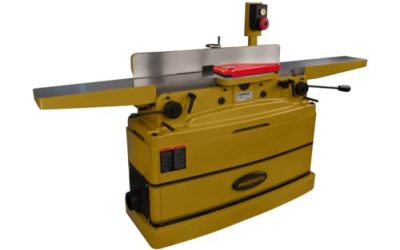
Powermatic PJ-882HH
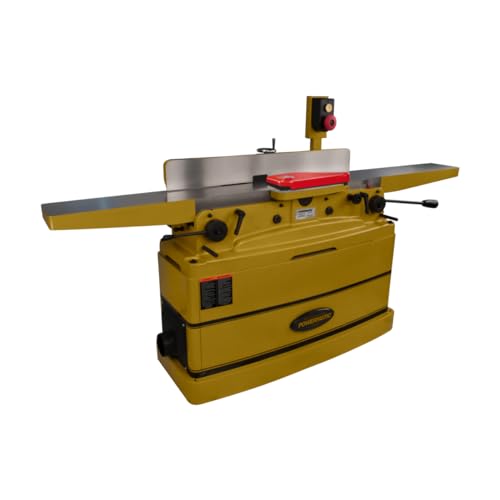
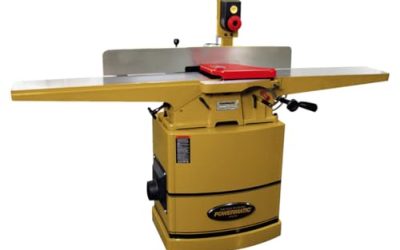
This is the jointer a cabinet shop buys once and builds its milling routine around. The 8-inch helical head carries 54 four-sided carbide inserts, so figured door stock comes off the bed with far less tear-out than a knife head leaves behind, and the parallelogram tables keep their relationship to the cutterhead as you change depth. At 82 inches of overall bed length it flattens long cabinet sides and door rails without the board tipping off the tables, and the 2 HP motor holds speed through full-width cuts in hard maple.
Specs
- Cutting width: 8 inches
- Cutterhead: helical, 54 four-sided knife inserts
- Motor: 2 HP, single phase, 230V
- Bed length: 82 inches overall
- Table design: parallelogram, heavy cast iron
- Fence: tilts with positive stops at 45 and 90 degrees
- Weight: 744 pounds
- Included: cutterhead guard, two push blocks, five spare knife inserts
Best for: A busy cabinet shop that wants one floor jointer for everything from face frames to wide panels.
Watch out for: It needs a 230-volt circuit and nearly 750 pounds of floor commitment, so plan the delivery route and placement before ordering.
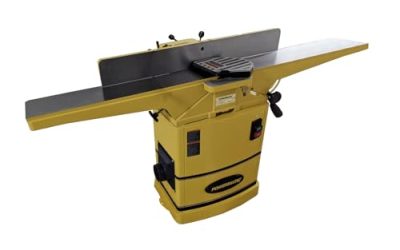
JET JJ-6HHDX

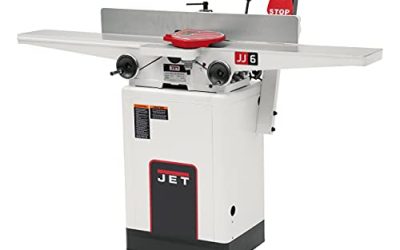
Shops whose cabinet parts stay narrow get the full helical benefit here without paying for width they never use. The long 56-inch cast iron bed is the quiet star: it supports long face-frame rails properly, which is where short-bed 6-inch machines usually disappoint. The helical head runs 27 four-sided carbide inserts at 6,000 RPM, and the 1 HP motor is prewired for 115 volts yet converts to 230 volts if your shop grows into it. The fence tilts both ways with positive stops at 45 and 90 degrees for bevelled edge work.
Specs
- Cutting width: 6 inches
- Cutterhead: helical, 27 four-sided carbide inserts in 4 rows
- Cutterhead speed: 6,000 RPM
- Motor: 1 HP, single phase, 115/230V, prewired 115V
- Table size: 56 inches long
- Fence: two-way tilting, positive stops at 45 and 90 degrees
- Dust port: 4 inches
Best for: One- and two-person cabinet shops jointing stiles, rails and face frames on a floor-standing machine.
Watch out for: Six inches of width will not face-joint a wide panel or one-piece drawer side, so pair it with a planer sled routine or a wider machine for those parts.
JET JJP-12HH

Floor space, not width, is the constraint this machine answers. It combines a 12-inch jointer and a thickness planer in a single footprint, and both functions share a helical cutterhead with 56 indexable carbide inserts, so wide cabinet panels get the same shear-cut finish as narrow rails. The jointer table measures 55 by 12 inches, generous support for door panels and glued-up tops, and the 3 HP motor handles the full width without slowing. For a small cabinet shop that cannot house two separate floor machines, it collapses the whole flattening workflow into one station.
Specs
- Jointing width: 12 inches
- Cutterhead: helical, 56 indexable carbide inserts
- Motor: 3 HP, single phase, 230V, 12.5 amps
- Cutterhead speed: 5,500 RPM
- Jointer table: 55 x 12 inches
- Machine type: planer/jointer combination
- Style: floor standing with stand included
Best for: Space-limited cabinet shops that need 12-inch face jointing and thickness planing from one machine.
Watch out for: Changing between jointing and planing modes takes a conversion step each time, and the machine needs a 230-volt circuit.
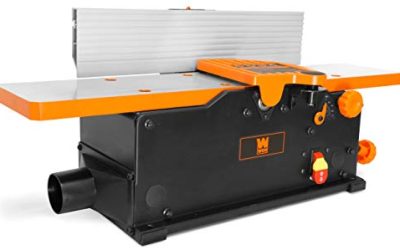
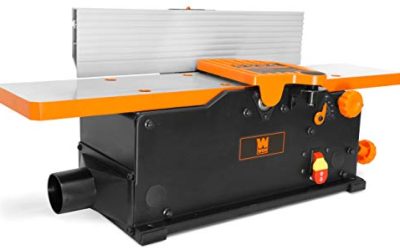
Wahuda 8-Inch Benchtop Jointer
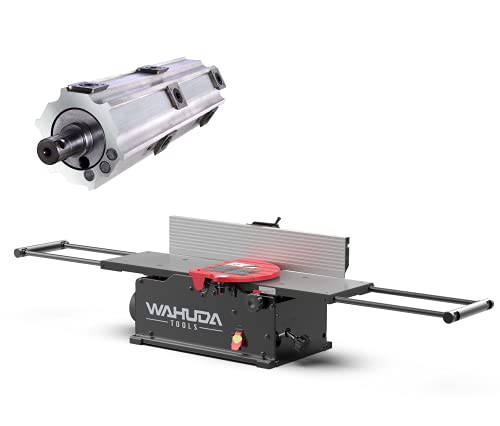
Benchtop jointers used to mean six inches and stamped tables; this one breaks both habits. The cast iron tables run 34 inches and pull-out extensions stretch support to 51 inches, so cabinet door rails stay registered instead of seesawing. Its spiral cutterhead uses four-sided carbide tips driven by a 10-amp motor at 12,000 RPM on a standard 120-volt outlet, and at roughly 50 pounds it can move from bench to stand to storage as the job demands. The aluminium fence tilts to 90 and 135 degrees for chamfers and bevels on edge profiles.
Specs
- Cutting width: 8 inches
- Cutterhead: spiral, four-sided carbide insert tips
- Motor: 10 amps, 120V, 12,000 RPM
- Tables: cast iron, 34 inches extending to 51 inches
- Fence: aluminium, tilts 90 and 135 degrees
- Item weight: 49.9 pounds
- Model: 50180CC-WHD
Best for: Garage and small-shop cabinet makers who need 8-inch capacity but cannot dedicate floor space to it.
Watch out for: A benchtop this light needs a rigid, flat bench or stand to stay accurate, and depth of cut per pass should stay modest on full-width hardwood.
Cutech 401120HI-IF

Width is the whole argument here: twelve inches of spiral cutterhead on a benchtop machine lets you face-joint cabinet panels and wide door blanks that normally demand a floor jointer or a planer sled. The head holds 24 tungsten carbide inserts in six staggered rows, turned by a 12-amp motor, the strongest in this benchtop class on these listings. Cast iron tables and an extra-large 24 by 6 inch cast iron fence keep wide stock honest, and the listing includes additional fence enhancement brackets for support. At nearly 117 pounds it is benchtop in footprint only; give it a permanent, sturdy home.
Specs
- Cutting width: 12 inches
- Cutterhead: spiral, 24 tungsten carbide inserts in 6 rows
- Inserts: two-sided, indexable
- Motor: 12 amps, 120 volts, 1,440 watts
- Tables: cast iron
- Fence: cast iron, 24 x 6 inches, with enhancement brackets
- Item weight: 116.8 pounds
- Model: 401120HI-IF
Best for: Cabinet makers who face-joint wide panels and glue-ups but work in a shop without room for a floor jointer.
Watch out for: The inserts are two-sided rather than four-sided, so each insert offers one rotation before replacement, and the weight makes it a poor candidate for moving between benches.
Which One Fits Your Situation
You Mill Rough Lumber for a Full Cabinet Kitchen at a Time
Volume changes the maths. Long bed support, an 8-inch width and a 2 HP induction motor keep the Powermatic PJ-882HH cutting at the same pace on the fortieth board as the first, and its 54 inserts share the wear across a big batch. Smaller machines will do the job, but you will feel every compromise by mid-afternoon.
Your Shop Is a Garage Bay and Everything Has to Move
Portability with real capacity points to the Wahuda 8-inch. It covers face frames and most door parts, its tables extend for longer rails, and it stores on a shelf or stand when the car needs its space back. If your garage work centres on wide panels instead, the Cutech trades easy moving for twelve inches of width.
You Build Mostly Face Frames, Doors and Drawers From Narrow Stock
The JET JJ-6HHDX is the honest match. Cabinet components in this work rarely pass six inches, and the long bed, tilting fence and 115-volt-friendly motor fit a small shop’s wiring and workflow. The money a wider machine would have consumed is better spent on the planer and dust collection that complete the milling chain.
One Machine Has to Flatten and Thickness Your Stock
Choose the JET JJP-12HH and accept the changeover as the price of the footprint. Twelve inches of jointing width handles panels outright, the planer side finishes the second face, and the shared helical head means one set of inserts to stock and rotate for both jobs.
Jointer Safety Checks
A helical head is quieter than a knife head, not gentler. Keep the cutterhead guard in place and correctly tensioned so it swings back over the head after every pass, and use push blocks on face jointing and on any stock your hands would pass near the head. Respect the minimum stock length in your machine’s manual: short pieces can tip into the cutterhead and kick back. Never reach over a spinning head to clear offcuts, and let it stop fully before retrieving anything. When rotating or replacing inserts, unplug the machine or lock out the switch first, since the work happens with your fingers on the head itself. Finally, connect dust collection; fine hardwood dust on the floor is a slipping hazard and in the air a breathing one, so wear respiratory and eye protection as standard practice.
Common Mistakes
- Buying width for imagined projects instead of the stock you actually milled last month, then crowding the shop with a machine that blocks everything else.
- Ignoring the electrical requirement and discovering after delivery that the 230-volt jointer has no circuit to run on.
- Taking deep passes across the full width of a benchtop machine, which bogs the motor and leaves a worse finish than two light passes.
- Forgetting that inserts differ between brands and even between models, so the spare inserts in the drawer do not fit the new head.
- Skipping the fence check: jointing for weeks against a fence that sits a fraction off square, then fighting every glue-up at assembly.
Frequently Asked Questions
Is a helical head worth it for cabinet work specifically?
For cabinet stock, usually yes. Doors, face frames and panels use figured and grain-reversing hardwoods that tear out under straight knives, and tear-out on a show face means extra sanding or a scrapped part. The shearing action of staggered inserts reduces that damage, and the head runs noticeably quieter during long milling sessions.
Can a benchtop spiral jointer replace a floor jointer in a cabinet shop?
It can for edge jointing and narrower face work, especially the 8-inch Wahuda with its extending tables. The limits are bed length, mass and motor stamina on long, wide hardwood. Shops regularly flattening cabinet sides and long rails will outgrow a benchtop; shops building smaller casework may never need more.
How long do carbide inserts last before they need rotating?
Inserts outlast high-speed steel knives by a wide margin because carbide holds an edge far longer, and each insert offers fresh edges by rotation, four on four-sided inserts and two on the Cutech’s two-sided pattern. Actual life depends on species, grit in the lumber and depth of cut, so rotate on finish quality, not a calendar.
Do I still need a thickness planer if my jointer is 12 inches wide?
Yes. A jointer flattens one face and squares one edge; it cannot make the opposite face parallel or bring stock to a uniform thickness. That is the planer’s job, which is exactly why combination machines like the JJP-12HH exist and why a wide jointer alone does not complete a milling setup.
More from Amazon
Programs that pair well with the guide above. Offers and eligibility are set by Amazon and may change.
Free shipping on eligible items, Prime Video and more. Eligible new members can start with a free trial.
Start a Prime free trialAudiobooks and podcasts to listen to on the go. Eligible new members can start with a free trial.
Try Audible freeAd-free music streaming. Eligible new subscribers can start with a free trial.
Try Music Unlimited freeA free business account with business pricing and bulk-buying tools for work, shop or home office.
Create a business accountAs an Amazon Associate we earn from qualifying purchases.

Write Your Review
No reviews yet. Be the first to share your experience!