

Key takeaways
- Compare five floor standing jointers for renovation work, from a 6-inch cabinet model to 8-inch helical and parallelogram machines on mobile bases.
Renovation work runs on reclaimed and rough-sawn lumber, and none of it arrives flat. A floor standing jointer earns its footprint by turning cupped, twisted boards into stock with one true face and one square edge, which is the starting point for tight trim, flat glue-ups, and doors that close properly. The real decision is capacity and power: a 6-inch cabinet machine on household current, or an 8-inch machine that needs a 230-volt circuit but swallows wide boards whole.
This guide is for renovators, cabinet installers, and serious home-shop owners who have outgrown a benchtop unit. The five picks below are all cabinet or closed-stand floor machines, spanning a dual-voltage 6-inch Grizzly with a V-helical head, three 8-inch Shop Fox models in knife, helical, and parallelogram form, and a 2 HP JET with a one-piece closed stand.
Quick Picks
As an Amazon Associate we earn from qualifying purchases
| Product | Best for | Key spec |
|---|---|---|
| Grizzly G0814X 6-Inch Jointer with Stand | Small shops on standard household power | V-helical cutterhead, 110V or 220V |
| Shop Fox W1857 8-Inch Dovetail Jointer | Straight-knife value in the 8-inch class | 3 HP motor, 72-inch cast-iron bed |
| Shop Fox W1858 8-Inch Dovetail Jointer | Helical finish on long boards | 36 indexable carbide inserts |
| Shop Fox W1859 8-Inch Parallelogram Jointer | Table accuracy that stays parallel | 76-inch parallelogram beds |
| JET JWJ-8HH 8-Inch Jointer | A closed-stand 8-inch machine from a major brand | 2 HP motor, helical cutterhead |
How to Choose
Cutting Width and Bed Length
Width decides which boards you can face in one pass. A 6-inch jointer handles most trim, flooring offcuts, and cabinet parts, but reclaimed beams and wide shelving stock quickly exceed it, and face-jointing a wide board in overlapping passes is not an option. An 8-inch machine covers the bulk of renovation lumber in a single pass. Bed length matters just as much: a 72-inch or 76-inch bed supports long boards so the ends do not tip and dig in mid-cut, while a 48-inch bed asks for roller stands on anything beyond short stock.
Cutterhead Style
Straight knives are the traditional choice: three or four long blades that are inexpensive to replace but need careful setting, and a nicked knife leaves a ridge along the whole board. Helical and V-helical heads replace the long knives with rows of small indexable carbide inserts. Each insert can be rotated to a fresh edge when it dulls or chips, and the angled inserts shear the wood rather than chop it, which the listings credit with smoother finishes and quieter running. For renovation stock hiding grit, old finish, and the occasional missed staple, individual replaceable inserts are a practical advantage.
Table Adjustment Design
On dovetail-way machines, the tables slide on angled cast-iron ways as they rise and fall, a simple and durable system that can drift if the gibs wear or loosen. Parallelogram designs mount each table on a linkage of arms, so the table stays close to the cutterhead and parallel to it through the whole height range, and depth changes come from a lever rather than long handwheel travel. If a shop re-sets depth often between face and edge work, the parallelogram layout is the easier one to keep accurate over years of use.
Power, Voltage, and Mobility
Check the circuit before anything else. The 6-inch Grizzly in this guide runs prewired at 110 volts and converts to 220, so it works in a garage shop as delivered. Every 8-inch pick here needs 230-volt single-phase power, and planning a dedicated circuit is part of the purchase. These machines weigh several hundred pounds, so a built-in mobile base is more than a convenience: it lets one person roll the jointer out for long boards and park it against a wall afterward, and four of the five picks include one.
The 5 Best Options
Grizzly G0814X 6-Inch Jointer with Stand and V-Helical Cutterhead
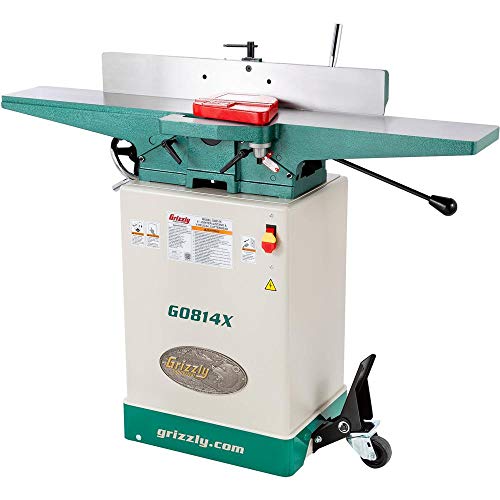
The G0814X is the pick for a renovation shop that works on standard household power. Its 1 HP motor ships prewired for 110 volts and can be converted to 220, and the one-piece cabinet stand includes a built-in mobile base for shops that rearrange around each job. The 4-row V-helical cutterhead uses indexable carbide inserts instead of full-width knives, so a chip from gritty reclaimed stock means rotating one small insert, not re-setting a knife set. The 47-inch cast-iron bed is the shortest here, which suits trim, flooring, and cabinet parts better than long beams.
Specs
- Motor: 1 HP, 110V/220V single-phase, prewired 110V, 14A at 110V and 7A at 220V
- Maximum width of cut: 6 inches
- Maximum depth of cut: 1/8 inch
- Cutterhead: 4-row V-helical with indexable carbide inserts
- Table: precision-ground cast iron, 47 x 6-5/8 inches, dovetail ways
- Fence: 4 x 29-1/8 inches with stops at 45, 90, and 135 degrees
- Stand: one-piece cabinet stand with built-in mobile base
- Overall dimensions: 47-1/2 x 20 x 42 inches
Best for: Garage and basement renovation shops that only have 110-volt power available.
Watch out for: The 6-inch width and 47-inch bed are the limits of this class; wide or long stock will push you toward the 8-inch picks below.
ASIN: B0892V27XF
Shop Fox W1857 8-Inch Dovetail Jointer with Mobile Base

The W1857 is the straightforward way into the 8-inch class: a 3 HP, 230-volt motor, a 72-inch precision-ground cast-iron bed, and a conventional 4-knife cutterhead. For renovators who already own a knife-setting jig and prefer the low running cost of resharpenable steel knives, that head is a feature, not a compromise. The tables ride on dovetailed ways with heavy cast-iron handwheels, the fence is center-mounted, and the pedestal-mounted magnetic switch sits within easy reach during long passes. A built-in mobile base and a two-year warranty round out a machine aimed at daily shop work.
Specs
- Motor: 3 HP, 230V single-phase
- Table size: 72 x 9 inches, precision-ground cast iron
- Table adjustment: dovetailed ways
- Cutterhead: 4-knife, 3-1/16 inch diameter
- Maximum depth of cut: 1/8 inch
- Fence size: 4-5/8 x 38 inches
- Switch: pedestal-mounted magnetic switch
- Mobility: built-in mobile base
- Warranty: 2 years
Best for: Renovators who want 8-inch capacity with traditional knives they can sharpen and set themselves.
Watch out for: It needs a 230-volt circuit, and straight knives demand careful setting after each sharpening to avoid ridges.
ASIN: B07PPJH75L
Shop Fox W1858 8-Inch Dovetail Jointer with Helical Cutterhead and Mobile Base

The W1858 pairs the same 72-inch dovetail platform as its knife-equipped sibling with a 4-row helical cutterhead carrying 36 indexable carbide inserts. Each insert rotates to expose a fresh edge, which suits renovation lumber that hides sand, old finish, and grit that would nick a full-width knife in one pass. The 3 HP motor turns the head at 5,500 RPM, the center-mounted fence adjusts by rack and pinion, and the listing includes a pair of push blocks and five spare inserts in the box. It is the balanced pick for shops flattening long, wide boards every week.
Specs
- Motor: 3 HP, 230V single-phase, 12A
- Maximum width of cut: 8 inches
- Maximum depth of cut: 1/8 inch
- Maximum rabbeting depth: 1/2 inch
- Cutterhead: 4-row helical with 36 indexable carbide inserts, 15 x 15 x 2.5 mm
- Cutterhead speed: 5,500 RPM
- Table size: 72 inches long, precision-ground cast iron
- Fence size: 4-5/8 x 38 inches
- Mobility: built-in mobile base
- Warranty: 2 years
Best for: Shops that face-joint wide, rough renovation boards and want insert-level repair instead of knife setting.
Watch out for: At roughly 450 pounds shipping weight, delivery and placement need planning, and it requires 230-volt power.
ASIN: B07YJ41N6F
Shop Fox W1859 8-Inch Parallelogram Jointer with Mobile Base

The W1859 stretches the bed to 76 inches and swaps dovetail ways for a parallelogram table design, where linkage arms keep both tables parallel to the cutterhead and close to it at any depth setting. Table height adjusts with levers and a depth gauge instead of long handwheel cranking, which speeds up changeovers between light facing passes and deeper edge work. The 3 HP motor, center-mounted fence with rack-and-pinion adjustment, and stops at 45 and 90 degrees carry over from the rest of the line, as does the built-in mobile base in the cabinet stand.
Specs
- Motor: 3 HP, 230V single-phase
- Maximum width of cut: 8 inches
- Table size: 9 x 76 inches, precision-ground cast iron
- Table adjustment: parallelogram with lever-adjusted height and depth gauge
- Cutterhead speed: 5,500 RPM
- Fence size: 4-5/8 x 38 inches with stops at plus or minus 45 and 90 degrees
- Fence adjustment: center-mounted with rack and pinion
- Mobility: built-in mobile base in cabinet stand
- Approximate shipping weight: 470 pounds
- Warranty: 2 years
Best for: Accuracy-focused shops jointing long stock that re-set cutting depth often.
Watch out for: This is the straight-knife parallelogram model; the helical version is a separate listing, so confirm the cutterhead before ordering.
ASIN: B07YJ4Y728
JET JWJ-8HH 8-Inch Jointer with Helical Head

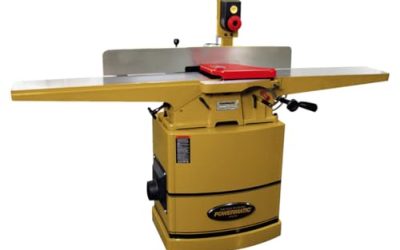
The JWJ-8HH is the established-brand option in this group: a 2 HP, 230-volt motor, an 8-inch helical cutterhead with indexable carbide inserts, and a heavy-duty one-piece steel closed stand. The extra-long cast-iron infeed and outfeed tables give long renovation boards full support, and the two-way tilting fence has positive stops at 45 and 90 degrees for bevel work on trim and handrail stock. Large chrome handwheels handle table adjustments, and the high-mount switch keeps the controls clear of the workpiece path. It trades the third horsepower of the Shop Fox machines for JET’s dealer network and long model history.
Specs
- Motor: 2 HP, 230V single-phase
- Maximum width of cut: 8 inches
- Cutterhead: helical with indexable carbide inserts
- Tables: extra-long cast-iron infeed and outfeed tables
- Fence: two-way tilting with positive stops at 45 and 90 degrees
- Stand: heavy-duty one-piece steel closed stand with mounting tabs
- Controls: front-mounted handwheels and high-mount switch
Best for: Buyers who want an 8-inch helical jointer from a long-running brand with wide parts availability.
Watch out for: The listing notes the machine ships without a plug, so budget for the correct 230-volt plug and circuit before it arrives.
ASIN: B07CMWL5JK
Which One Fits Your Situation
Your Shop Only Has Household Power
Choose the Grizzly G0814X. It is the only machine here that runs as delivered on a 110-volt circuit, and its cabinet stand with a built-in mobile base suits a garage that has to give the car its space back at night. The V-helical head handles gritty reclaimed boards gracefully, and the 6-inch capacity covers trim, flooring, and cabinet parts, which is most of what a typical room-by-room renovation produces.
You Flatten Wide Reclaimed Boards Every Week
Choose the Shop Fox W1858. The 8-inch width takes most salvaged boards in one pass, the 72-inch bed keeps long stock supported, and the 36-insert helical head shrugs off the grit and old finish that reclaimed lumber carries. When an insert chips, you rotate it and keep working instead of stopping to set knives, which matters when a whole floor’s worth of boards is waiting.
You Chase Dead-Flat Results on Long Stock
Choose the Shop Fox W1859. Its 76-inch parallelogram beds hold long boards without end droop, and the linkage keeps the tables parallel to the cutterhead through every depth change, so a setting made in the morning is still true in the afternoon. Lever adjustment with a depth gauge makes repeatable light passes easy, which is exactly what flattening long, slightly twisted stock calls for.
You Prefer a Major Brand and Dealer Support
Choose the JET JWJ-8HH. The closed steel stand, helical head, and two-way tilting fence cover the same work as the other 8-inch picks, and JET’s long-running model line means knives, inserts, and parts stay easy to source years from now. The 2 HP motor is a step down on paper, but for one-pass depths within the listed 1/8-inch maximum it is matched to the machine’s intended work.
Common Mistakes
- Buying an 8-inch, 230-volt jointer before confirming the shop has, or can get, a suitable circuit and plug.
- Choosing a benchtop jointer for renovation lumber, then fighting short beds and lightweight tables on every long board.
- Running reclaimed stock without scanning for nails and staples first, which chips knives and inserts alike.
- Taking the full 1/8-inch depth in one pass on wide hardwood instead of making two lighter passes.
- Skipping the mobile base on a machine this heavy, then never moving it and losing half the shop’s flexibility.
Frequently Asked Questions
Is a 6-inch jointer enough for home renovation work?
For most of it, yes. Trim, flooring, cabinet parts, and standard dimensional lumber all fit within 6 inches, and a cabinet-stand model like the G0814X adds the bed length and stability a benchtop cannot. The limit appears with wide salvaged boards and one-piece shelving stock, which need either an 8-inch machine or a different milling strategy.
What is the difference between dovetail ways and parallelogram tables?
Dovetail-way tables slide on angled cast-iron tracks as they move, a simple design that works well but can drift as the gibs wear. Parallelogram tables hang from linkage arms, so they stay parallel to the cutterhead and close to it at every height. The parallelogram design also adjusts by lever, which makes small, repeatable depth changes faster.
Do helical cutterheads really need less maintenance?
They change the maintenance rather than removing it. A nicked straight knife needs removal, sharpening, and careful resetting across the full width. A damaged helical insert is one small carbide square: loosen it, rotate it to a fresh edge, and tighten it again. Inserts cost more per set than knives, but downtime per incident is far lower, especially with dirty reclaimed stock.
Can a floor standing jointer replace a thickness planer?
No, they do different halves of the job. A jointer makes one face flat and one edge square to it, but it cannot make the opposite face parallel or set a finished thickness. The standard sequence is jointer first for a reference face and edge, then a thickness planer for the second face, then the table saw for the final edge.
More from Amazon
Programs that pair well with the guide above. Offers and eligibility are set by Amazon and may change.
Free shipping on eligible items, Prime Video and more. Eligible new members can start with a free trial.
Start a Prime free trialAudiobooks and podcasts to listen to on the go. Eligible new members can start with a free trial.
Try Audible freeAd-free music streaming. Eligible new subscribers can start with a free trial.
Try Music Unlimited freeA free business account with business pricing and bulk-buying tools for work, shop or home office.
Create a business accountAs an Amazon Associate we earn from qualifying purchases.

Write Your Review
No reviews yet. Be the first to share your experience!