

Key takeaways
- Compare the best floor standing jointers for weekend woodworking projects, with long cast iron beds, helical or knife cutterheads, and enclosed stands.
Weekend projects live or die on board preparation. A twisted, cupped board will fight every glue-up and leave gaps no clamp can close, so the real decision is which floor standing jointer gives you flat faces and square edges without eating your whole Saturday on setup. Bed length, cutterhead style, and the stand underneath the machine matter more than raw cutting width for most home shops.
This guide is for hobbyists building furniture, cabinets, and cutting boards in a garage or basement shop on weekends. Every machine below is a full-size floor model on its own stand or cabinet, chosen from the names and specifications printed on its Amazon product page. Each pick was also checked for a listed weight and footprint that match a stationary machine rather than a benchtop unit, so nothing here needs a workbench to sit on.
Quick Picks
As an Amazon Associate we earn from qualifying purchases.
| Product | Best for | Key spec from title |
|---|---|---|
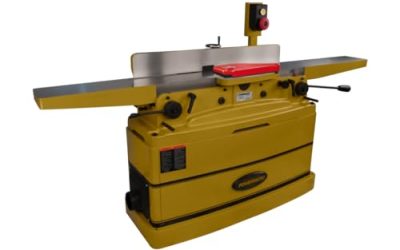
| Powermatic 6-Inch Jointer, Helical Cutterhead (Model 54HH) | Quiet, smooth cuts on figured weekend-project stock | Helical Cutterhead, 1 HP, 115/230V 1Ph |
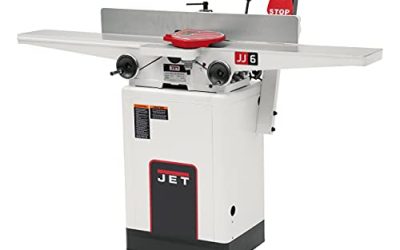
| JET 6-Inch Long Bed Jointer, Helical Cutterhead (JJ-6HHDX) | Long boards for tables and bookcases | Helical Cutterhead, 1 HP, 115/230V 1Ph |
| JET 6-Inch Long Bed Jointer, Straight Knife Cutterhead (JJ-6CSDX) | Simple knife changes on a classic long-bed machine | Straight Knife Cutterhead, 1 HP, 115/230V 1Ph |
How to Choose
Bed Length and Table Support
Bed length decides how long a board you can flatten reliably, because the stock has to stay registered against the tables before and after the cutterhead. Short beds let long boards tip and dip, which shows up as snipe or a hollow in the middle of the edge. For weekend furniture work, look for the longest combined infeed and outfeed tables your floor space allows. Cast iron tables also hold their flatness over years of use, and their weight damps vibration. Measure your shop doorway and the wall space the machine will occupy before ordering, since these jointers arrive as heavy freight.
Cutterhead Style: Knives or Helical Inserts
A straight knife cutterhead uses two or three long knives that take a full-width bite on every pass. Knives are simple and leave a clean surface when sharp, but one nick means resetting the whole set. A helical cutterhead carries many small four-sided carbide inserts in staggered rows. Each insert can be rotated to a fresh edge when nicked, and the shearing action runs quieter with less tear-out on figured grain. For weekend woodworkers who joint cherry, walnut, and maple with reversing grain, inserts reduce sanding time later. Knife machines still suit straight-grained softwoods and simple project lumber well.
Motor, Voltage, and Wiring
Most floor standing jointers in this class run a 1 HP motor wired for either 115 or 230 volts, and many arrive prewired for 115 so they plug into a standard shop circuit. Running on 230 volts can give the motor an easier start under load, but only if your shop already has that circuit near the machine. Check the amperage printed on the product page against the breaker that serves your garage, and plan a dedicated circuit if your lights already dim when other tools start. A motor enclosed inside the stand or cabinet also stays cleaner, since dust falls away from it.
Stand, Fence, and Dust Collection
The stand is part of the machine, not an accessory. An enclosed steel cabinet adds mass that keeps the jointer planted during heavy passes, and it often houses the motor and switch within reach. An open steel stand saves a little floor weight but should still bolt down solidly. Check the fence next: it should lock firmly, tilt for bevel work, and return to a positive stop at square without guesswork. Finally, confirm the dust port diameter on the listing, because a jointer produces long shavings that clog undersized hoses quickly. Match the port to the collector or shop vacuum hose you already own.
The 3 Best Options
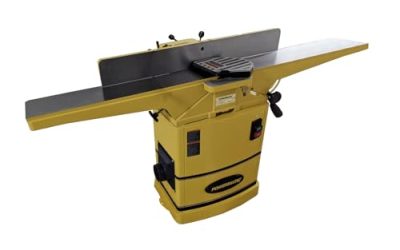
Powermatic 6-Inch Jointer, Helical Cutterhead, 1 HP, 115/230V 1Ph (Model 54HH)

The 54HH suits weekend woodworkers who mill figured hardwood and want a quiet machine that leaves a finish-ready surface. Its helical cutterhead carries forty four-sided carbide inserts, so a nick from a hidden staple or hard knot becomes a quick insert rotation instead of a full knife reset. The long tables support tabletop panels and door stock, and the included stand keeps the motor enclosed and the machine steady. If your projects lean toward walnut, cherry, and curly maple, this is the pick that protects that grain.
Specs
- Brand: Powermatic
- Model Number: 54HH
- Manufacturer Part Number: 1791317K
- Cutting width: 6 inches
- Cutterhead: Helical, 40 four-sided indexable carbide inserts
- Amperage: 13 A
- Input Voltage: 115 volts
- Power Source: Corded Electric
- Material: Alloy Steel, Cast Iron
- Item Length: 66 inches
- Included Components: Jointer, Fence, Guard, Stand, Dust Chute, Push Blocks, Handles, Hardware
Best for: Weekend builders jointing figured hardwood who want quiet helical cutting and long table support.
Watch out for: Confirm your dust hose fits the dust chute, and plan help for moving the machine, since the stand and tables ship as heavy freight.
ASIN: B001AZV2OM
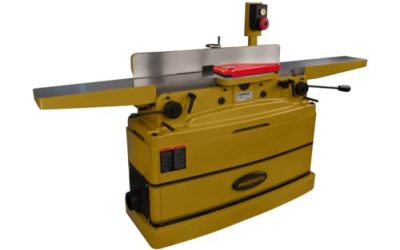
JET 6-Inch Long Bed Jointer, Helical Cutterhead, 1 HP, 115/230V 1Ph (JJ-6HHDX)

The JJ-6HHDX is built around extra-long cast iron tables, which makes it the natural choice when your weekend projects involve six-foot tabletop boards, bookcase sides, or door rails that a short bed cannot register properly. The helical cutterhead spins at the listed speed with small carbide inserts, giving a shearing cut that stays quiet in a residential garage. The stand is part of the package, along with push blocks and a dust chute. Woodworkers who want helical smoothness plus the longest support in this group should start here.
Specs
- Brand: Jet
- Model Number: JJ-6HHDX
- Manufacturer Part Number: 708466DXK
- Cutting width: 6 inches
- Maximum Rotational Speed: 6000 rpm
- Item Weight: 237 pounds
- Material: Alloy Steel, Cast Iron
- Base Material: Cast Iron
- Style: Long Bed Helical Head Jointer
- Included Components: Jointer, Stand, Dust Chute, Push Blocks (x2), Hardware, Tools
Best for: Weekend woodworkers flattening long boards for tables, bookcases, and doors.
Watch out for: Measure the full footprint and doorway path first, because the long bed and 237-pound weight need a permanent spot in the shop.
ASIN: B0011TLVEI
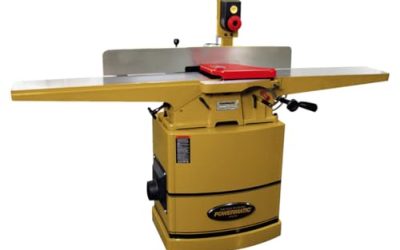
JET 6-Inch Long Bed Jointer, Straight Knife Cutterhead, 1 HP, 115/230V 1Ph (JJ-6CSDX)

The JJ-6CSDX keeps the same long-bed layout in a straight knife design, which appeals to woodworkers who prefer simple, widely available replacement knives and a traditional setup routine. The listing describes quick-set knives that speed up changes, and the package includes the stand with the motor, the fence assembly, push blocks, and guards. At 237 pounds on an enclosed base, it stays planted during deep passes on rough lumber. If your weekend work is mostly straight-grained pine, oak, and poplar for shop furniture and home repairs, this machine covers it without insert-by-insert maintenance.
Specs
- Brand: Jet
- Model Number: JJ-6CSDX
- Manufacturer Part Number: 708457DXK
- Cutting width: 6.13 inches
- Cutting Depth: 0.5 inches
- Maximum Rotational Speed: 6000 rpm
- Amperage: 13 A
- Item Dimensions: 56 x 22 x 37.5 inches
- Item Weight: 237 pounds
- Material: Alloy Steel, Cast Iron
- Included Components: Stand with Motor, Bed Assembly, Fence Assembly, Cutterhead Guard, Belt Guard, V-Belt, Hardware, Tools, Push Blocks, Handwheel Assembly, Fence Handle
Best for: Weekend woodworkers who prefer straight knives and joint mostly straight-grained project lumber.
Watch out for: Budget time for knife setting after each change, and keep a spare knife set on hand so a nick does not stall a weekend build.
ASIN: B000BHNAJA
Which One Fits Your Situation
You Build Furniture From Figured Hardwood
Cherry tabletops, walnut shelves, and curly maple drawer fronts punish a jointer that tears out grain, because every torn patch means extra scraping and sanding later. Choose the Powermatic 54HH. Its forty indexable carbide inserts shear figured grain cleanly, individual inserts rotate when nicked, and the long tables keep wide panels registered. For a weekend builder whose lumber costs more than the machine time, that finish quality is the deciding factor.
You Flatten Long Boards in a Garage Shop
Tabletop glue-ups and bookcase sides often start as boards longer than five feet, and those boards need support on both sides of the cutterhead from start to finish. Choose the JET JJ-6HHDX. The long bed design is the point of this model, and the helical cutterhead keeps noise down for a residential garage. Set it along a wall with clear infeed and outfeed room, and long stock stops being the hardest part of your Saturday.
You Want Simple Upkeep and Mostly Straight-Grained Lumber
If your projects run on pine shelving, poplar paint-grade trim, and red oak furniture, a straight knife machine keeps maintenance familiar and inexpensive. Choose the JET JJ-6CSDX. Quick-set knives simplify changes, the enclosed stand keeps the motor out of the dust, and the long tables handle the same board lengths as the helical models. It is the straightforward option when insert management sounds like more system than your weekends need.
Your Shop Circuit Is Already Loaded
A jointer that trips the breaker mid-pass ruins the board, so check the amperage on the listing against your panel before choosing. All three machines list a 1 HP motor with dual-voltage wiring, so any of them can move to a 230-volt circuit if you add one. Until then, run the jointer on its own circuit, keep other big tools off that line, and let the dust collector start first so the two motors never surge together.
Common Mistakes
- Buying by cutting width alone and ignoring bed length, then discovering that long tabletop boards rock on short tables and come off the machine with dips and snipe.
- Skipping the electrical check and plugging a 13-amp jointer into a shared garage circuit that already runs lights, a compressor, and a dust collector, which guarantees tripped breakers mid-pass.
- Forgetting dust collection entirely, even though jointers throw long shavings that pack into the cutterhead guard and chute, choke airflow, and bury the stand in chips within a few boards.
- Taking deep passes to save time instead of several light ones, which overloads the motor, tears grain, and leaves a surface that needs far more sanding before glue-up.
- Placing the machine without measuring doorways, turning space, and infeed and outfeed clearance, then finding that six-foot boards cannot physically travel through the cutterhead in the chosen spot.
Frequently Asked Questions
Is a 6-inch jointer wide enough for weekend furniture projects?
For most weekend furniture, yes. Tabletops and panels are glued up from narrower boards anyway, and boards under six inches wide cover the majority of project parts. When a wider board appears, many woodworkers rip it, joint the pieces, and glue them back together, which also relieves internal stress. Width matters less than bed length for the flat, straight results weekend projects need.
What is the difference between a helical cutterhead and straight knives?
Straight knives are long blades that span the cutterhead and take a full-width cut each revolution. A helical cutterhead uses many small four-sided carbide inserts arranged in staggered rows, and each insert shears the wood at a slight angle. Inserts run quieter, handle figured grain with less tear-out, and rotate to a fresh edge when nicked, while knives cost less to replace as a set.
Can these jointers run on a normal household circuit?
The models in this guide list 1 HP motors with 115/230-volt wiring and arrive ready for standard shop power, but the listed draw is 13 amps, which is most of a typical 15-amp garage circuit. Run the jointer on a dedicated circuit where possible, start the dust collector separately, and avoid sharing the line with other large tools during a pass.
How much floor space does a floor standing jointer need?
Plan for the machine footprint plus room at both ends, because boards travel the length of the beds and beyond. A six-inch long-bed jointer is fifty-six to sixty-six inches long before you add clearance, so most owners park it along a wall with several feet of open space in front of the infeed and behind the outfeed. Measure your longest typical board and double that space if you can.
More from Amazon
Programs that pair well with the guide above. Offers and eligibility are set by Amazon and may change.
Free shipping on eligible items, Prime Video and more. Eligible new members can start with a free trial.
Start a Prime free trialAudiobooks and podcasts to listen to on the go. Eligible new members can start with a free trial.
Try Audible freeAd-free music streaming. Eligible new subscribers can start with a free trial.
Try Music Unlimited freeA free business account with business pricing and bulk-buying tools for work, shop or home office.
Create a business accountAs an Amazon Associate we earn from qualifying purchases.

Write Your Review
No reviews yet. Be the first to share your experience!