

Key takeaways
- Five helical head jointers for garage workshops compared, from compact 6-inch benchtop models to wide 12-inch cast iron picks, with safety guidance.
A garage jointer has to earn its bench space. The real decision is not helical against straight knives, it is how wide a board you need to flatten against how much room, weight, and electrical capacity your garage can spare. A six-inch benchtop machine stores on a shelf and runs on a standard household circuit, while a twelve-inch cast iron jointer flattens wide slabs but needs a dedicated bench and two people to move.
This guide is for garage woodworkers who buy rough lumber and need one flat face and one square edge before the planer and table saw take over, for furniture hobbyists working with figured grain that tears out under straight knives, and for small-shop owners who want quieter cuts and inserts they can rotate instead of knives they must reset. Every pick below is a helical or spiral cutterhead jointer chosen from its Amazon product title and listing specifications, with the cutterhead type stated on the listing.
Quick Picks
As an Amazon Associate we earn from qualifying purchases.
| Product | Best for | Key spec from title |
|---|---|---|
| WEN JT630H 10-Amp 6-Inch Spiral Benchtop Jointer | A first jointer in a tight single-car garage | 6-inch spiral cutterhead with 12 HSS blades |
| Cutech 40180HI 8-Inch Spiral Cutterhead Benchtop Jointer | Cast iron stability for wider boards on a bench | 8-inch spiral cutterhead with 16 TC inserts |
| Wahuda Tools 50180CC-WHD 8-Inch Spiral Cutterhead Jointer | Longer boards with pull-out table extensions | 8-inch spiral cutterhead with 4-sided carbide tips |
| JET JJ-6HHBT 6-Inch Helical Head Benchtop Jointer | Figured wood and a true helical cut in a compact frame | Helical cutterhead with 14 carbide blades, 1 HP |
| Cutech 401120HI-IF 12-Inch Spiral Cutterhead Benchtop Jointer | Flattening the widest boards a benchtop can handle | 12-inch spiral cutterhead with 24 TC inserts |
How to Choose
Cutting Width and Table Length
Cutting width is the hard limit on your work. A six-inch jointer flattens boards up to six inches wide, which covers most edge jointing and narrow face jointing, while an eight-inch machine opens up wider panels and a twelve-inch machine handles full-width slabs. Table length matters just as much, because a jointer flattens a board by referencing the part already cut, so short beds struggle with long stock. As a rough guide, a benchtop jointer handles boards up to about twice its total bed length before accuracy falls away. Measure the longest boards you actually buy, then check the table dimensions on the listing, not just the width.
The Cutterhead Itself
Helical and spiral heads both use small square inserts arranged in rows around the cutterhead instead of two or three full-length straight knives, and sellers use the two words loosely, so read the listing rather than the label. Carbide inserts stay sharp far longer than high-speed steel inserts and can be rotated to a fresh edge when one side dulls, while high-speed steel inserts cost less to replace. The shearing cut of a segmented head also tears out less on figured or reversing grain and runs noticeably quieter than straight knives. Confirm the insert count and material on the product page before buying.
Power, Weight, and Garage Circuits
Most benchtop jointers in this guide run on a standard 115-volt household circuit, with motors from 10 amps up to a 1 HP 15-amp motor on the JET. A stronger motor holds speed better in dense hardwood and on deeper passes, but it also draws more current, so check what else shares that garage circuit before you start a cut. Weight is the other garage trade-off: a light machine near 37 pounds lifts on and off a bench easily, while a cast iron machine over 80 pounds stays put and resists vibration but needs a permanent spot or a mobile base. Decide where the jointer will live before you order it.
Safety, Dust Collection, and Fence Setup
A jointer is one of the few shop machines where your hands pass directly over an exposed cutterhead, so safety habits decide the purchase as much as specifications do. Always use the push blocks that ship with the machine, keep the cutterhead guard in place, and never joint stock shorter than the safe minimum in the manual, since short pieces put your hands too close to the cutterhead and can kick back without warning. Feed with steady pressure on the outfeed table, and never reach over a spinning head. Hook up dust collection or a shop vacuum to the dust port, because a garage fills with chips, and check the fence for square before every session.
The 5 Best Options
WEN JT630H 10-Amp 6-Inch Spiral Benchtop Jointer
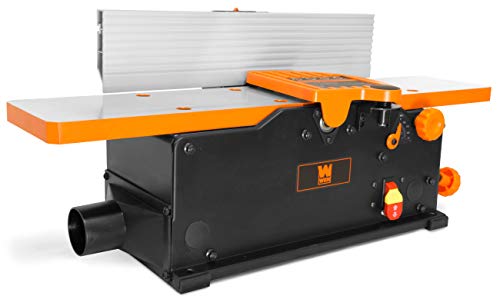
The WEN JT630H is the sensible starting point for a garage shop that has never owned a jointer. Its six-inch spiral cutterhead and compact table fit on a standard workbench, it runs on a normal household circuit, and at under 37 pounds it lifts off the bench and onto a shelf when the car needs the space back. The spiral head with staggered inserts still gives cleaner cuts on tricky grain than the straight-knife jointers this machine replaces, which makes it a strong match for hobbyists flattening narrow boards and squaring edges for glue-ups.
Specs
- 6-inch cutting width
- Spiral cutterhead with 12 HSS blades
- 10-amp motor
- Table measures 30 by 6 inches
- Maximum depth of cut of 0.12 inches per pass
- Weight of 36.82 pounds
Best for: A first jointer in a small garage where the machine must share bench space and be stored between sessions.
Watch out for: The six-inch width and short beds limit face jointing on wide or long boards, so measure your typical stock before ordering.
Cutech 40180HI 8-Inch Spiral Cutterhead Benchtop Jointer

The Cutech 40180HI is the step up for garage woodworkers who keep running into the six-inch limit. Its eight-inch spiral cutterhead carries sixteen two-sided tungsten carbide inserts in six rows, and the cast iron tables give the machine a rigid, vibration-resistant base that holds alignment through long sessions. The extra-long aluminum fence with additional brackets supports bevel work and keeps tall boards steady, which matters when you edge joint long pieces in a tight space. This is the pick for someone who has outgrown a compact jointer but still needs a benchtop footprint.
Specs
- 8-inch spiral cutterhead
- 16 two-sided tungsten carbide inserts in 6 rows
- Cast iron tables
- Extra-long 24-inch aluminum fence
- Additional 7-3/8-inch fence brackets
- 10-amp motor
- Dimensions of 34 by 19.75 by 13.25 inches
- Weight of 82.8 pounds
Best for: Garage furniture makers who need eight inches of face-jointing width and cast iron stability on a bench.
Watch out for: At nearly 83 pounds this is a two-person lift, so plan a permanent bench spot or a mobile base before it arrives.
Wahuda Tools 50180CC-WHD 8-Inch Spiral Cutterhead Jointer
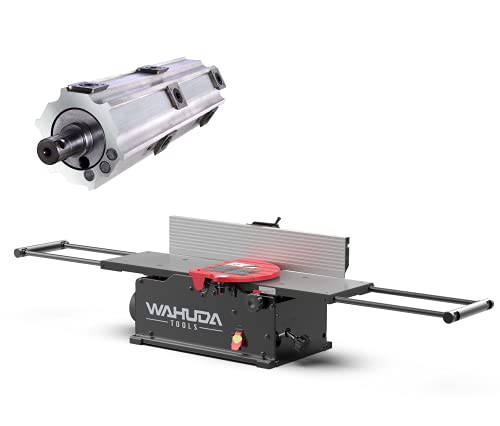
The Wahuda 50180CC-WHD suits garage shops that joint longer boards than a standard benchtop table supports. Its cast iron tables come with pull-out extensions that add support at both ends, so a long board stays level through the cut instead of tipping off the infeed or outfeed side. The spiral cutterhead uses four-sided carbide tips that can be rotated to a fresh edge, and the ten-amp motor covers the usual range of hardwoods a garage woodworker buys. It is lighter than other cast iron eight-inch jointers, which helps when bench space has to be rearranged.
Specs
- 8-inch cutting width
- Spiral cutterhead with 4-sided carbide tips
- Cast iron tables with pull-out extensions
- 10-amp motor
- Dimensions of 34 by 14 by 13 inches
- Weight of 49.9 pounds
Best for: Jointing longer boards in a garage where pull-out table extensions add support without a floor-standing machine.
Watch out for: Check that the pull-out extensions lock flat and level with the tables during setup, since any step at the joint shows up in the cut.
JET JJ-6HHBT 6-Inch Helical Head Benchtop Jointer

The JET JJ-6HHBT is the premium six-inch option for garage woodworkers who care most about cut quality on figured wood. Its true helical head holds fourteen indexable four-sided carbide blades that shear the grain instead of chopping it, which keeps tearout down on curly maple, interlocked grain, and other boards that straight knives chew up. The one-horsepower motor turns the cutterhead at ten thousand revolutions per minute, and the heavy-duty cast iron tables and fence give the machine a solid feel that lighter benchtop jointers cannot match. It ships with a push block and push stick in the box.
Specs
- 6-inch cutting width
- Helical cutterhead with 14 indexable four-sided carbide blades
- 1 HP motor
- 15-amp motor on a 115-volt circuit
- Cutterhead speed of 10,000 RPM
- Maximum cutting depth of 0.13 inches
- Heavy-duty cast iron tables and fence
- Fence tilts 45 degrees in both directions
- Internal blower moves dust and chips away from the motor and cutterhead
- Includes a push block and a push stick
- Weight of 71 pounds
Best for: Woodworkers who joint figured or reversing-grain boards and want a true helical cut in a benchtop frame.
Watch out for: The fifteen-amp draw needs a circuit with enough headroom, and the machine cannot cut a rabbet because of the table shape and fixed guard.
Cutech 401120HI-IF 12-Inch Spiral Cutterhead Benchtop Jointer

The Cutech 401120HI-IF is the widest benchtop jointer in this guide, built for garage shops that flatten wide slabs and glue up broad panels. Its twelve-inch spiral cutterhead carries twenty-four tungsten carbide inserts, and the cast iron tables and extra-large cast iron fence keep wide boards supported and square through the cut. The twelve-amp motor handles the wider cutterhead, and the additional fence enhancement brackets steady the fence at both ends. This machine weighs over 111 pounds, so treat it as a semi-permanent station rather than a tool you lift on and off a bench.
Specs
- 12-inch spiral cutterhead
- 24 TC inserts
- Cast iron tables
- Extra-large 24 by 6 inch cast iron fence
- Additional 8.5-inch fence enhancement brackets
- 12-amp motor
- Dimensions of 34 by 23.75 by 13.25 inches
- Weight of 111.8 pounds
Best for: Flattening wide boards and panels in a garage with a dedicated bench station for the jointer.
Watch out for: Confirm the bench and floor can carry a machine over 111 pounds, and arrange help for lifting it into place.
Which One Fits Your Situation
Your Garage Is Tight and This Is Your First Jointer
Choose the WEN JT630H. Its six-inch width covers edge jointing and narrow face jointing, its light weight lets you store it on a shelf when the car comes home, and its ten-amp motor runs on a standard household circuit. You give up wide-board capacity, but you gain a machine that actually fits the space you have.
You Keep Hitting the Six-Inch Limit on Wider Boards
Choose the Cutech 40180HI. The eight-inch spiral head with sixteen carbide inserts flattens boards a six-inch machine cannot touch, and the cast iron tables hold alignment better than aluminum beds. If you joint long boards often, the Wahuda 50180CC-WHD is the alternative, since its pull-out extensions support stock the Cutech tables cannot reach.
You Work With Figured Wood That Tears Out Easily
Choose the JET JJ-6HHBT. Its true helical head with fourteen four-sided carbide blades shears figured and reversing grain more cleanly than the spiral heads on the budget machines, and the one-horsepower motor holds speed through dense hardwood. The six-inch width still limits face jointing, so pair it with a planer sled for wide figured slabs.
You Flatten Wide Slabs and Glue Up Broad Panels
Choose the Cutech 401120HI-IF. Twelve inches of spiral cutterhead with twenty-four carbide inserts flattens boards that no other benchtop jointer in this guide can handle, and the cast iron tables and fence keep wide stock square. Give it a permanent bench station, since at over 111 pounds it is not a machine you move between sessions.
Common Mistakes
- Jointing stock that is too short to hold safely, which puts your hands over the cutterhead and invites kickback; use a planer sled or cut the piece to a safe length first.
- Taking a deep cut on the first pass instead of several light passes, which strains the motor and leaves a rough, torn surface.
- Skipping dust collection in an enclosed garage, where fine chips coat every surface and the air in minutes.
- Buying the widest jointer without measuring the bench, the doorway, and the circuit it will run on.
- Forgetting to check the fence for square and the tables for level after moving the machine, which shows up as tapered edges and gaps in glue joints.
Frequently Asked Questions
What is the difference between a helical and a spiral cutterhead?
Both use square inserts arranged in rows around the cutterhead instead of straight knives, and sellers use the two terms loosely. A true helical head angles each insert to shear the wood in sequence, while a spiral head seats the inserts in a spiral pattern around the drum. Either way, you get quieter cuts, less tearout on figured grain, and inserts you rotate instead of knives you must reset.
Can a benchtop jointer flatten a wide board?
A benchtop jointer can only flatten a board as wide as its cutterhead, so a six-inch machine flattens boards up to six inches wide and an eight-inch machine handles boards up to eight inches wide. For a board wider than the cutterhead, face joint one side in two passes with a planer sled, or rip the board, joint the pieces, and glue them back together after flattening.
How long a board can a garage jointer handle?
A jointer flattens by referencing the part of the board already cut, so bed length sets the practical limit. As a rough guide, a benchtop jointer handles stock up to about twice its bed length before the unsupported ends tip and accuracy falls away. Pull-out table extensions help, and infeed roller stands support longer boards, but long stock belongs on a floor-standing jointer with long cast iron beds.
Do I need dust collection for a jointer in a garage?
Yes, and it matters more in a garage than in an open shop. A jointer throws a large volume of chips and fine dust on every pass, and an enclosed garage traps it in the air and on every stored item. Connect a shop vacuum or dust collector to the dust port before the first cut, wear eye and hearing protection, and sweep up after each session.
More from Amazon
Programs that pair well with the guide above. Offers and eligibility are set by Amazon and may change.
Free shipping on eligible items, Prime Video and more. Eligible new members can start with a free trial.
Start a Prime free trialAudiobooks and podcasts to listen to on the go. Eligible new members can start with a free trial.
Try Audible freeAd-free music streaming. Eligible new subscribers can start with a free trial.
Try Music Unlimited freeA free business account with business pricing and bulk-buying tools for work, shop or home office.
Create a business accountAs an Amazon Associate we earn from qualifying purchases.

Write Your Review
No reviews yet. Be the first to share your experience!