

Key takeaways
- One transfer chair passed a strict two-part check for a rotating seat and locking casters. See the verified model, maker specs, limits and fit checks.
As an Amazon Associate, we earn from qualifying purchases made through links on this page.
Moving a person from a bed to a toilet, a sofa or a car seat is one of the hardest parts of home care, and a transfer chair with a rotating seat is built to make that turn easier. Instead of dragging the whole chair around or asking the seated person to shuffle their hips in small steps, the caregiver turns the seat itself, lines the person up with the surface they are moving to, and completes the transfer with far less pulling. Locking casters matter just as much: the chair has to roll freely while it is being positioned, then stay completely still while someone is sitting down, being lifted or being lowered.
The problem is that product listings blur these two features. Many chairs advertise swivel wheels and call the chair a swivel model, even though the seat never turns. Others use a split seat that opens sideways so the chair can be backed around a seated person; that is a useful design, but the seat does not rotate. For this guide we applied a strict two-part check to every transfer chair we could find on Amazon US: the maker must state that the seat itself rotates, and the maker must state that the casters lock. Both points had to come from the maker’s own product information, not from a headline written by a third party.
The honest result is a short list. Only one model passed both parts of the check with clear maker-stated specifications: the Toptople Hydraulic Patient Lift Transfer Chair, model TP-001. Rather than pad this guide with chairs that miss one of the two requirements, we cover that single verified model in depth, explain exactly what to check if you shop beyond it, and show why the most common transfer chair designs were left out. If your transfer routine depends on a seat that turns and casters that lock, this is the chair that currently documents both.
What to look for in a rotating seat transfer chair
A seat that truly rotates
The seat should turn on its own axis, the way a turntable does, so a caregiver can change the direction the seated person faces without moving the base of the chair. This is the feature that helps in tight bathrooms and beside a bed, where there is often no room to swing a whole chair around. When you read a listing, look for plain wording such as rotating seat or swivel seat tied to the seat itself. Treat two phrases with caution. Swivel casters describe the wheels, which spin so the chair can change direction while rolling; nearly every transfer chair has them, and they say nothing about the seat. A split seat, sometimes listed as opening to 180 degrees, describes two seat halves that swing open to either side so the chair can collect a seated person without lifting them; again, the seat does not turn as a unit. Neither phrase confirms a rotating seat.
Casters that lock, and how many
A locking caster has a brake the caregiver can press to stop the wheel rolling while a transfer is under way. Check how many of the casters lock. Some chairs lock all four, which is the most secure arrangement. Others, including the model in this guide, lock the two front casters and rely on the caregiver holding the chair from behind during the lift. Neither arrangement is automatically wrong, but you should know which one you are buying, because the locking step has to happen before every sit-down and every lift. Also check the caster size and whether the maker describes them as quiet or indoor wheels, since small hard casters can struggle on thick carpet and across raised thresholds.
Lift type and height range
Transfer chairs raise and lower the seat so it can meet a bed, a toilet or a car seat at a similar height. Manual hydraulic models use a pump action worked by the caregiver and need no charging, which suits homes where the chair must always be ready. Electric models lift at the push of a button and reduce caregiver effort, but they add a battery that must be kept charged. Whichever type you choose, compare the stated lift range with the heights in your home: the top of the mattress, the toilet seat, and the seat of any wheelchair the person also uses. A chair whose range does not reach your bed height will not solve the transfer it was bought for.
Rated capacity, stated plainly
Capacity figures on transfer chairs are not always presented in one consistent way. A listing may give a frame capacity and a separate maximum weight recommendation, and the two numbers can differ. Use the lower, more cautious figure when you match the chair to the person who will sit in it, and leave a margin rather than planning to sit exactly at the limit. If two sources for the same model give different figures, treat that as a flag to confirm the figure on the product page before ordering, which is exactly the situation with the model below.
Cushions and toileting
Most lift transfer chairs are also used for toileting, so they ship with an open-seat cushion that leaves a commode opening, plus a full cushion that closes the seat for ordinary sitting and moving around the home. A two-cushion setup is more flexible than a single fixed seat, because the same chair can handle a bathroom trip and a move to the living room without swapping equipment. Check what the cushions are made from and whether they can be wiped clean, since bathroom use makes easy cleaning a daily concern rather than a minor detail.
Fit at home and in the car
Measure before you order. The chair has to pass through your doorways, turn in the bathroom, and reach the side of the bed with enough room for the caregiver to stand and work the lift. Some models are also shaped to serve a car transfer, but the maker may limit that use to the front passenger seat of a compact sedan, because the seat height and door opening of larger vehicles do not line up with the chair. If car transfers are part of your plan, confirm that your vehicle matches the maker’s stated limits instead of assuming any car will work.
Who the chair is not for
Every chair in this category is caregiver equipment. The seated person must be able to sit upright, with support, and help at least slightly during the move. These chairs are not a substitute for a full sling lift for someone who cannot sit up or bear any part of the transfer, and the makers say so in their own safety notes. Reading that section of a listing before you buy is as important as any measurement.
The verified pick: Toptople Hydraulic Patient Lift Transfer Chair (TP-001)

See the Toptople TP-001 on Amazon
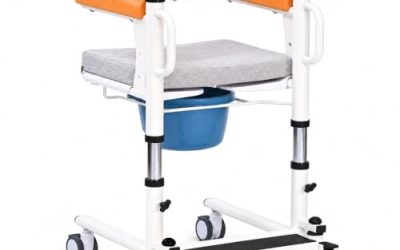
The Toptople TP-001 is a manual hydraulic patient lift transfer chair, and it is the one model we found whose maker states both required features in plain terms. The seat rotates through a full turn so the caregiver can align the seated person with a bed, sofa, wheelchair, toilet or car seat, and the chair rolls on four quiet casters with locking brakes on the two front casters. That pairing is the whole point of this guide: the rotation handles the aiming, and the front locks hold the chair steady while the person is seated, lifted or lowered.
Height adjustment comes from the hydraulic lift, which raises and lowers the seat across a stated range of 32 to 40 inches. Because the lift is manual, there is no battery to charge and no powered control to learn; the caregiver works the lift and guides the chair from behind, which the maker recommends for balance during transfers. The frame is alloy, and the chair folds, so it can be stored in a smaller space or carried in a car between homes, although folding should not be confused with light: this is a substantial piece of care equipment that one person will find awkward to carry far.
For daily care, the TP-001 ships with two cushions. The open-seat cushion supports toileting and shower-adjacent routines, and the full cushion gives a closed seat for ordinary sitting and for moving around the home. Both cushions are built on a firm base with high-density foam, which suits longer seated periods better than a thin pad. The chair is aimed at bed, sofa, wheelchair, toilet and car transfers, and the maker presents it as a single device that can cover the full daily circuit for a person who is cared for at home.
On capacity, read the figures with care. The maker’s listing data gives a frame capacity of 400 lb and a maximum weight recommendation of 450 lb. We also found one retailer mirror of this model stating a lower support figure, which is why the capacity check in the section above matters: confirm the current figure on the product page, and match the person to the cautious figure with room to spare.
Who it suits: a caregiver who transfers one person several times a day between a bed, a toilet and seating, in a home where space is tight enough that turning the seat is easier than turning the chair. It also suits households that want a hydraulic chair with no battery routine, and anyone whose transfer plan includes the front seat of a compact sedan.
Limitations to weigh, based on the maker’s own specifications:
- Only the two front casters lock. The rear casters roll freely, so the caregiver must hold the chair during each lift, as the maker instructs.
- Car use is narrow: the maker limits car transfers to the front passenger seat of a compact sedan, and rules out larger vehicles and rear seats.
- It is caregiver equipment only. The maker states it must not be used independently, and it is not suitable for a person who cannot sit upright or who is completely unable to take part in the transfer.
- The capacity figures are not presented consistently across sources, so the figure needs confirming on the product page before you rely on it.
- A manual hydraulic lift asks more of the caregiver than an electric model; if the caregiver has limited strength, that effort is part of the decision.
Why other transfer chair designs were left out
Most transfer chairs sold today fail one half of the two-part check, and it is worth knowing which half, because the listings rarely make it obvious. Split-seat lift chairs, the most common design in this category, open their two seat halves sideways and close them around a seated person. That is a genuinely helpful mechanism, and these chairs usually have locking casters, but the seat does not rotate as a unit, so they were excluded under the strict rule for this guide. Swivel shower benches and swivel tub transfer benches do have a seat that turns, often locking at right angles, but they stand on fixed legs or suction feet for use across a bathtub; they have no casters at all, so they cannot roll a person from room to room. Rolling shower and commode chairs have casters with brakes, but their seats are fixed. Stand-assist transfer aids help a person who can support much of their own weight to pivot while standing, which is a different task from a seated rotating transfer. If your routine does not truly need the seat itself to turn, one of those designs may serve you well; they simply do not meet the combined requirement this guide was built around.
Comparison table
| Model | Seat rotation (maker-stated) | Locking casters | Lift type | Frame capacity | Cushions included |
|---|---|---|---|---|---|
| Toptople TP-001 Hydraulic Patient Lift Transfer Chair | Yes, full-turn rotating seat | Yes, two front casters lock | Manual hydraulic, 32 to 40 in range | 400 lb (450 lb maximum weight recommendation) | Open-seat cushion and full cushion |
Frequently asked questions
What is the difference between a rotating seat and a split seat?
A rotating seat turns as one piece on its base, so the seated person ends up facing a new direction while the chair stays where it is. A split seat opens into two halves that swing to either side, letting the chair be positioned around a person who is already seated, then closed beneath them. The split design removes the need to lift the person onto the chair; the rotating design removes the need to turn the whole chair during the transfer. They solve different problems, and a listing that mentions one has not promised the other.
Do all four casters need to lock?
Locking all four is the most secure arrangement, but it is not the only workable one. On the Toptople TP-001 the two front casters lock and the maker directs the caregiver to push and hold the chair from behind, which keeps the rear under control during a transfer. What matters is that the locking casters are engaged before anyone sits down or is lifted, every time, and that the person helping understands which wheels on their chair have brakes and which do not.
Can this chair be used without a caregiver?
No. The maker states that this type of chair must be used with a caregiver, and that it is not designed for independent use. The seated person also needs to be able to sit upright with support. For someone who cannot sit up or take any part in the move, a full sling lift is the appropriate category of equipment instead.
Can it transfer someone into a car?
Within limits. The maker describes car transfers for the front passenger seat of a compact sedan, and specifically rules out larger vehicles and rear seats, because the chair’s lift range and the car’s seat height and door opening have to line up. If the car transfer is the main reason for buying, check your vehicle’s seat height against the chair’s 32 to 40 inch lift range before ordering.
What should I measure before ordering?
Measure the width of the doorways the chair must pass through, the height of the bed and any other surface the person transfers to, and the space beside the bed and around the toilet where the caregiver will stand. Weigh the person who will use the chair and compare that figure with the maker’s cautious capacity figure, leaving a margin. Finally, confirm the capacity figure on the product page itself, since sources for this model do not all state the same number.
Conclusion
A rotating seat and locking casters are a specific pairing, and most transfer chairs only document one of the two. Under a strict check of maker-stated specifications, the Toptople TP-001 hydraulic transfer chair is the model that documents both: a full-turn rotating seat for aiming the transfer, and locking front casters to hold the chair while it happens. Its limits are equally clear: front-only locks, a manual lift, caregiver-only use, and car transfers confined to a compact sedan’s front seat. If those limits fit your home and your routine, it is the verified choice for this category. If they do not, use the checks in this guide to read other listings closely, and be wary of any chair whose swivel claim turns out to describe only its wheels.
More from Amazon
Programs that pair well with the guide above. Offers and eligibility are set by Amazon and may change.
Free shipping on eligible items, Prime Video and more. Eligible new members can start with a free trial.
Start a Prime free trialAudiobooks and podcasts to listen to on the go. Eligible new members can start with a free trial.
Try Audible freeAd-free music streaming. Eligible new subscribers can start with a free trial.
Try Music Unlimited freeA free business account with business pricing and bulk-buying tools for work, shop or home office.
Create a business accountAs an Amazon Associate we earn from qualifying purchases.




Write Your Review
No reviews yet. Be the first to share your experience!