

Key takeaways
- The one compact massage chair with a verified Amazon listing, checked on upright footprint, space-saving recline, track type and the features its listing actually states.
A massage chair is the largest piece of furniture most homes ever add, and “compact” is where listings earn or lose your trust. The honest measures are the upright footprint, how much wall clearance the recline demands, and whether the chair slides forward as it reclines or swings its back into the wall behind it. A chair that fits the room on paper but needs a metre of empty wall behind it is not compact in any sense that matters to the room it lands in.
One chair passed this guide’s verification: a model whose Amazon listing could be cross-checked across multiple indexed sources, whose dimensions are stated plainly, and whose space-saving claim is mechanical rather than rhetorical — its base slides forward as it reclines, recovering floor space that a conventional recliner consumes. Other chairs marketed as compact either could not be tied to a verifiable in-stock listing, or their listings described full-size furniture under a compact headline. What follows is the one chair that checks out.
Quick Picks
As an Amazon Associate we earn from qualifying purchases.
| Product | Best for | Key spec from title |
|---|---|---|
| Osaki OS-Champ Massage Chair | Small rooms needing a full-body chair with a space-saving recline | L-track chair with space-saving forward slide |
How to Choose
Judge compactness by upright footprint plus recline clearance
Two numbers decide whether a chair fits: the space it occupies upright, and the space its recline reaches into. The OS-Champ’s listing states upright dimensions of 57.1 by 30 by 44.1 inches, and its space-saving design slides the whole chair forward as the backrest lowers, which the listing describes as recovering up to 9 inches of floor. Measure your room for the upright footprint first, then check what stands behind the chair’s position — a forward-slide design forgives a wall-hugging placement that defeats a conventional recliner.
Track type decides where the rollers actually reach
The listing states an L-track, which carries the rollers from the neck down the back and under the seat to the glutes and upper legs. An S-track stops at the lower back. For a home relaxation routine — the keyword’s purpose — the L-track’s under-seat reach is the difference between a back massage and a full posterior-chain session, and it is achieved here without a larger chair. When comparing listings, treat the track letter as a coverage specification and be wary of listings that avoid naming one at all.
Count the routine features you will genuinely use
A daily relaxation routine runs on a short list of features: automatic programs, heat, and a recline you can nap in. The OS-Champ’s listing states five automatic programs of 15 minutes each, two stages of zero gravity, lumbar heating pads and an extendable footrest of up to 7.6 inches — a coherent routine feature set rather than a novelty list. Eighteen airbags, per the listing details, cover shoulders, arms, calves and feet with compression. Read any candidate listing for these workhorse features first; exotic additions matter less than whether the basics suit an evening routine. A chair whose heat, programs and recline match your habits gets used nightly; one bought for a feature you try twice becomes furniture.
Check the user limits printed on the listing
Compact chairs trade size somewhere, and usually it is in the user envelope. This listing states a maximum weight recommendation of 250 pounds, and the chair’s listed weight is 235 pounds — a substantial piece of furniture despite the compact positioning, which matters for delivery, floor placement and any plan to move it between rooms. Taller users should note the footrest extension figure on the listing and the reclined length it implies. Matching the chair’s stated limits to the people who will actually use it is the unglamorous step that decides long-term satisfaction.
The 1 Best Options
1. Osaki OS-Champ Massage Chair

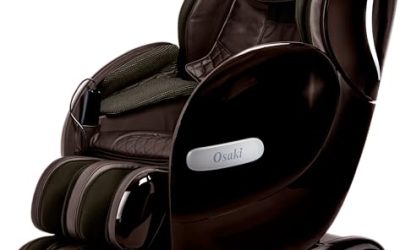
The OS-Champ is Osaki’s compact-format full-body chair, and its listing supports the claim with specifics rather than adjectives: an L-track roller system, two stages of zero gravity, five 15-minute automatic programs, eighteen airbags, lumbar heating, Bluetooth speakers and a footrest extending up to 7.6 inches, in a chair measuring 57.1 by 30 by 44.1 inches upright. The space-saving mechanism is the headline for small rooms — as the chair reclines, its base slides forward, recovering up to 9 inches of floor compared with a fixed-base recliner, so it can sit closer to a wall than its reclined length suggests. For a home relaxation routine in a spare room, apartment or bedroom corner, this is the combination that fits.
Specs (from the listing):
– Track: L-track
– Zero gravity: 2 stages
– Programs: 5 automatic programs, 15 minutes each
– Airbags: 18 (shoulders, arms, calves, feet)
– Heat: lumbar heating pads
– Footrest: extendable up to 7.6 inches; foot rollers
– Dimensions (upright): 57.1 x 30 x 44.1 inches
– Item weight: 235 lb
– Maximum weight recommendation: 250 lb
– Included: foot rest, owner’s manual, power cable, remote
Best for: Smaller living rooms, apartments and spare rooms where a full-body chair must earn its floor space and sit close to a wall.
Watch out for: At 235 pounds listed weight this is still a heavy delivery that needs its route into the room planned, and the 250-pound user limit on the listing excludes some buyers outright.
Which One Fits Your Situation
You have a small living room or apartment
The OS-Champ is built for this constraint. Its 30-inch width passes standard doorways, the upright footprint is modest for a full-body chair, and the forward-slide recline means the wall behind it does not need to stand empty. Place it where a conventional recliner would go and the room keeps the floor space the slide recovers. If your room defeated previous attempts at a massage chair on clearance grounds, this mechanism is the specific feature that changes the answer.
Your routine is an evening wind-down
The feature set reads like a wind-down checklist: pick one of the five 15-minute automatic programs, let the lumbar heat work, and settle into a zero-gravity stage while the airbags handle arms and calves. Fifteen-minute programs suit a daily habit better than marathon sessions — short enough to run every evening, structured enough that you are not adjusting settings mid-relaxation. The Bluetooth speakers on the listing round out the routine for those who pair massage with music or a podcast.
You are buying for a spare room or bedroom corner
A chair in a bedroom lives or dies on how it shares space with furniture that was there first. The compact upright footprint and wall-friendly recline let the OS-Champ take a corner without dominating it, and the L-track’s under-seat coverage means the smaller format does not quietly downgrade the massage itself. Check the delivery path as carefully as the destination: at the listed weight, stairs and tight turns are the real obstacles, not the room.
Several people of different builds will share the chair
Read the listing’s envelope honestly. The extendable footrest, up to 7.6 inches per the listing, adapts the chair to different leg lengths, and the automatic programs simplify shared use. But the stated 250-pound maximum and the compact frame mean this is not the household’s universal chair if a regular user exceeds those limits. For a household inside the envelope, it serves everyone; outside it, a larger-frame model is the correct purchase even at the cost of floor space.
Common Mistakes
- Measuring only the upright footprint and forgetting the recline, then discovering the chair’s back meets the wall or a bookshelf halfway down. Tape the reclined outline on the floor before delivery if you can; a chair that fits only until it leans back does not fit, and returning a freight-weight chair is nobody’s idea of a relaxing routine.
- Treating “compact” in a headline as a specification; the dimensions and the recline mechanism on the listing are the specification. Two chairs can share the word and differ by a foot in depth, so compare the printed measurements of any candidate against your doorway width and room depth, not the marketing label.
- Ignoring the user weight limit printed on the listing, which on compact chairs is lower than on full-size frames. A chair worked beyond its stated limit wears its mechanism early and gives the seller grounds to dispute a warranty claim, so match the limit to the heaviest regular user with room to spare.
- Planning the room but not the delivery route — a 235-pound chair that cannot turn on the landing does not reach the room it fits. Walk the route from the front door with a tape measure, count the turns and stair edges, and decide in advance whether the chair goes in assembled or needs a different entry.
- Comparing chairs by program count alone, when track type and airbag coverage decide what a routine actually feels like. Twenty programs on a short track still never reach your glutes; five well-chosen programs on an L-track cover more of you than a long menu on the wrong hardware.
Frequently Asked Questions
What makes a massage chair “compact”?
Two things: a smaller upright footprint than full-size chairs, and a recline that does not demand large wall clearance. The OS-Champ’s listing states dimensions of 57.1 by 30 by 44.1 inches upright, and its base slides forward during recline, recovering up to 9 inches of floor. A chair with small upright dimensions but a conventional recline arc is only compact until the first time you lean it back.
What is an L-track, and why does it matter for relaxation?
The track is the rail the rollers travel. An S-track follows the spine and stops at the lower back; an L-track continues under the seat, so the rollers reach the glutes and the backs of the thighs. For an evening relaxation routine that difference is felt immediately — the L-track covers the full line of muscles that sitting all day loads. The OS-Champ’s listing states an L-track, which is why it delivers full-body coverage from a compact frame.
How much space should I leave behind the chair?
With a forward-slide design like this one, much less than a conventional recliner needs, because the chair moves away from the wall as it reclines instead of into it. The listing describes the slide as recovering up to 9 inches of floor space. Still, measure your exact placement: confirm the upright footprint, recline the chair fully once installed, and check clearance against your own wall and furniture rather than trusting any generic figure.
Are five automatic programs enough for a daily routine?
For most home users, yes. The listing states five automatic programs of 15 minutes each, plus the manual techniques the chair offers, heat and two zero-gravity stages — variety enough that a daily routine does not become repetitive within a week, without a menu so deep it discourages use. Routine adherence is the real metric: a chair used nightly at 15 minutes delivers more than a feature-stuffed chair used monthly.
More from Amazon
Programs that pair well with the guide above. Offers and eligibility are set by Amazon and may change.
Free shipping on eligible items, Prime Video and more. Eligible new members can start with a free trial.
Start a Prime free trialAudiobooks and podcasts to listen to on the go. Eligible new members can start with a free trial.
Try Audible freeAd-free music streaming. Eligible new subscribers can start with a free trial.
Try Music Unlimited freeA free business account with business pricing and bulk-buying tools for work, shop or home office.
Create a business accountAs an Amazon Associate we earn from qualifying purchases.
Write Your Review
No reviews yet. Be the first to share your experience!