

Key takeaways
- Looking for the best portable patient lifts with emergency lowering? Compare two folding electric lifts by capacity, weight, lift range and manual lowering.
The best portable patient lifts with emergency lowering are the ones that keep working for the caregiver even when the power does not. A lift can have a strong motor and a comfortable sling, but if the battery runs out while someone is suspended in the air, the only thing that matters is whether the boom can be brought down slowly and under control. That is exactly what an emergency lowering feature is for, and it is the feature this guide is built around.
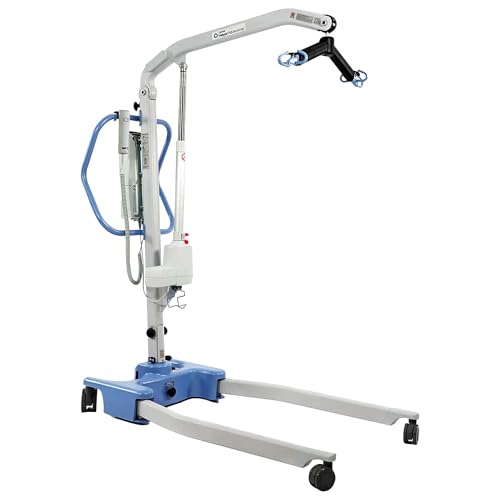

Portable here means a lift that folds or breaks down for storage and transport, rolls on casters through standard doorways, and fits in a home rather than a hospital ward. Both lifts below are battery-powered electric models with a documented emergency lowering system, a folding or compact frame, and a real Amazon US listing. Only two models met all three tests with a verifiable ASIN, so this guide covers two picks in depth rather than padding the list with lifts whose emergency lowering could not be confirmed or whose Amazon listing could not be verified.
What to Look For
The emergency lowering system itself
Not every lift that has an emergency stop button has emergency lowering, and the difference matters. An emergency stop button cuts power and freezes the boom where it is. Emergency lowering is a separate path that brings the boom down when the normal controls cannot.
There are two common designs. The first is a set of emergency lower and raise buttons on the control box, operated with the tip of a ballpoint pen, for use when the hand control fails. The second is a fully mechanical release that retracts the actuator without any electricity at all. The mechanical release only works while the lift is under load, and it lowers the boom slowly rather than dropping it. A lift that has both paths gives the caregiver a backup for a failed hand control and a backup for a total power failure. When you compare lifts, check the manual for both, and note whether the mechanical release needs a minimum load to operate.
Weight capacity and the margin around it
Capacity is the maximum load the maker states for the lift, and it should clear the weight of the person being transferred with room to spare. A 340 lb lift and a 450 lb lift serve different households, and the right choice depends on the person who will use it most. Capacity also interacts with the sling: the sling has its own stated capacity, and the lower of the two numbers is the limit for the combination. Check the sling capacity separately, and use only slings the maker lists as compatible with the lift.
Unit weight and folding
A portable lift has to be moved, and its own weight is part of that job. The lifts in this guide weigh roughly 70 lb and 109 lb, and the lighter one folds without tools and stands on its own when folded. If the lift will travel between rooms, between floors, or in a car, the folded dimensions and the folding mechanism matter as much as the weight. A no-tools fold that one person can manage is worth more than a lighter frame that needs two people and a wrench to take apart.
Lift range and base dimensions
Lift range is the distance between the lowest and highest positions of the sling attachment point. A lift that reaches down to around 15 inches can pick someone up from the floor, while a lift that reaches up past 60 inches can transfer onto a high bed. Base width matters too: the legs open wide for stability around a wheelchair or commode and close narrow to pass through doorways. Under-bed clearance, usually around 4.5 inches, decides whether the base slides under a bed or a low chair at all. Measure the doorways, the bed height, and the space around the commode before choosing, and compare those numbers with the dimensions in the specifications.
Battery, charging, and low-battery alerts
Battery-powered lifts run on a rechargeable battery pack with an onboard or wall-mounted charger. Two details deserve attention. The first is how many lifts the maker states per charge, because a lift that runs out mid-day is a lift that cannot finish a transfer. The second is the low-battery alert: an audible alarm or an LCD indicator that warns well before the battery is empty gives the caregiver time to finish the transfer and recharge. Some lifts will not operate while plugged in for charging, so plan charging around the transfer schedule rather than leaving the lift on charge between transfers.
Sling compatibility
A lift is only half of a transfer system; the sling is the other half. Check whether the lift uses a 6-point spreader bar or swivel bar, whether it accepts 2-point, 4-point, and 6-point slings, and whether a sling is included in the box. Many electric lifts ship without a sling, and the sling is chosen separately by size and style. The spreader bar design also affects how close the lift can get to the person: tapered or swan-neck legs and a rotating swivel bar help the lift approach a chair or commode closely.
Build, standards, and warranty
Look for a frame material the maker names, such as aluminum for lightness or steel for heavy-duty models, and for a stated safety standard. One lift in this guide lists EN ISO 10535, the global standard for patient lifts, in its specifications. Warranty terms are also worth reading in full: frame coverage and parts coverage are often different lengths, and batteries are usually covered for a shorter period than the frame.
Top Picks
1. Joerns Hoyer Advance Electric Portable Patient Lift
Joerns Hoyer Advance Electric Portable Patient Lift
The Hoyer Advance is the most portable lift in this guide, and it is the pick for homes where the lift needs to fold away, travel in a car, or fit through tight spaces. The aluminum frame weighs 69.9 lb, and the lift folds without tools into a shape that stands on its own for storage. Folded dimensions are 17.7 inches high by 46.5 inches deep by 21.7 inches wide, so it fits in a closet or a car trunk in a way a 109 lb steel lift does not.
The safe working load is 340 lb, and the lift range runs from 15.4 inches to 64.6 inches, with a maximum height to the attachment point of 66.5 inches. That low end is what lets it lift from the floor, and the high end covers transfers onto a bed, a chair, a commode, a shower seat, or a lift chair. The base measures 21.7 inches when closed and 45.7 inches when open, with legs that open to an inside dimension of 39.3 inches and close to an outside dimension of 26.3 inches. Under-furniture clearance is 4.7 inches, and the legs are 4.5 inches high overall. A foot pedal opens the base, leaving both hands free, and a push pad helps start movement with less force.
The emergency lowering system has two layers. Emergency lower and raise buttons sit on the rear of the control box, under the red emergency stop button, and are operated with the tip of a ballpoint pen if the hand control fails. If power fails completely, a mechanical lowering device takes over: pulling the red boss upward starts a slow descent, and the device only operates while the lift is under load. The control box also carries a Smart Monitor with an LCD display that shows lift use and maintenance data, a battery indicator, and a low-voltage alarm. The lift runs on a single 12V battery with an onboard charger, and the hand control plugs into a socket at the base of the control box.
The 6-point spreader bar works with the Hoyer range of slings, and the swan-neck leg design lets the lift get closer to the person being transferred. The listing states EN ISO 10535 compliance for this lift. The maker states a limited lifetime warranty on the aluminum frame and a 2-year warranty on parts. One point to check before ordering: the listing describes the lift itself, so confirm in the listing whether a sling is included or needs to be ordered separately in the right size.
The Advance suits a household that needs a lift in more than one place, or a caregiver who will move it alone. Its trade-off is capacity: at 340 lb it covers most home transfer needs, but households that need a larger margin should look at the 450 lb lift below.
2. Invacare Reliant 450 Power Lift with Power Opening Low Base (RPL450-2)
Invacare Reliant 450 Power Lift with Power Opening Low Base
The Invacare Reliant 450 RPL450-2 is the heavy-duty pick in this guide, built around a 450 lb capacity and a power-opening base. Where the Hoyer Advance folds for travel, the Reliant 450 is built for steady daily transfers in one home, with a steel frame, a wide lift range, and two batteries so a charged pack is always ready.
The height at the sling hook-up runs from 24 inches to 74 inches, which covers floor-level lifts and transfers onto high surfaces. The base is 48 inches long, 26.5 inches wide when closed and 41 inches wide when open, with 4.5 inches of under-bed clearance. The lift weighs 109 lb. The padded swivel bar rotates 360 degrees and has a six-point hookup, so it accepts chain-free Invacare slings as well as older slings with chains or straps. The base opens with power on this model, model number RPL450-2, rather than by a manual shifter handle.
Power comes from two removable 24V battery packs: one runs the lift while the other charges on the wall-mounted charging station, and the maker states 150 to 300 lifts per charge depending on the lift range and load. A low-battery audible alarm sounds when charging is needed, and the battery box on the mast carries an emergency off button. The hand pendant controls the boom and the base width.
The emergency lowering system is documented in the maker manual in detail. The primary mechanical emergency release is activated by inserting a pen into the hole marked “emergency” on the control box while pushing down on the boom. A secondary release is operated by pulling up on the red emergency grip while pushing down on the boom. Both releases let the actuator retract without power, and the actuator only retracts while under load. A red emergency stop button on the control box halts all lift movement at once, and an anti-entrapment feature stops the boom if it meets resistance while lowering.
The Reliant 450 suits households that need the higher capacity, that transfer the same person several times a day, and that have space for a 109 lb lift to stay assembled. Its trade-offs are weight and size: it does not fold for car travel the way the Advance does, and it needs room to store. The maker states a limited warranty of three years on the lift and one year on the battery. As with any lift, confirm the sling situation in the listing, and note that this model is the RPL450-2 with the power-opening base; the RPL450-1 is the same lift with a manual base.
Comparison at a Glance
| Lift | Weight Capacity | Unit Weight | Lift Range | Emergency Lowering | Base Width |
|---|---|---|---|---|---|
| Joerns Hoyer Advance Electric | 340 lb | 69.9 lb | 15.4–64.6 in | Control-box emergency buttons plus mechanical lowering device | 21.7 in closed / 45.7 in open |
| Invacare Reliant 450 RPL450-2 | 450 lb | 109 lb | 24–74 in at sling hook-up | Primary and secondary mechanical emergency releases | 26.5 in closed / 41 in open |
How to Practice the Emergency Lowering Feature
An emergency lowering feature only helps if the caregiver knows how to use it before it is needed. Read the manual section on emergency lowering for the lift you own, and walk through the steps with the lift empty first so the motion is familiar. On the Hoyer Advance, that means finding the emergency lower button on the rear of the control box and the red mechanical lowering boss, and knowing that the mechanical device only works while the lift is under load. On the Reliant 450, it means finding the hole marked “emergency” on the control box, the secondary emergency grip, and the red stop button, and knowing that both releases need a downward push on the boom while they are activated.
Practice also means checking the battery routine: keep a charged battery ready, pay attention to the low-battery alarm or indicator, and recharge before the battery runs low rather than after. Keep the manual where the lift is stored, and make sure anyone else who operates the lift has read the emergency section too. A lift that is used every day should have its emergency lowering checked as part of regular maintenance, following the schedule in the manual.
FAQ
What is the difference between an emergency stop and emergency lowering?
An emergency stop button cuts power and freezes the boom in place. Emergency lowering is a separate mechanism that brings the boom down in a controlled way when the normal controls or the power have failed. A lift can have one without the other, so check the manual for both features rather than assuming a stop button covers lowering.
Do these lifts work when the battery runs out?
The normal hand control does not work without battery power. That is why both lifts in this guide have a mechanical lowering path that works without electricity: the Hoyer Advance has a mechanical lowering device, and the Reliant 450 has primary and secondary mechanical emergency releases. Both only operate while the lift is under load, and both lower the boom slowly.
Are slings included with these lifts?
It depends on the listing. Many electric patient lifts ship without a sling, and the sling is ordered separately in the correct size and style. Both lifts here use multi-point attachment bars that accept several sling styles, but the sling itself has its own capacity and compatibility limits. Confirm what is in the box in the listing before ordering, and use only slings the maker lists as compatible.
Which lift should I choose: the Hoyer Advance or the Reliant 450?
Choose the Hoyer Advance if portability matters most: it is lighter, folds without tools, and fits in a car or a closet. Choose the Reliant 450 if capacity matters most: it supports up to 450 lb, has a power-opening base, and comes with two batteries so a charged pack is ready. If the person being transferred is near or above 340 lb, the Reliant 450 is the fitting choice of the two.
Conclusion
The best portable patient lifts with emergency lowering are not the ones with the longest feature list, but the ones whose backup systems are documented, mechanical, and easy to reach. The Joerns Hoyer Advance covers the portable end of the range: a 69.9 lb folding aluminum frame, a 340 lb capacity, and two layers of emergency lowering in the control box and the mechanical device. The Invacare Reliant 450 RPL450-2 covers the heavy-duty end: a 450 lb capacity, a power-opening base, two 24V batteries, and primary and secondary mechanical emergency releases.
Measure the doorways, the bed, and the transfer path first, then match the capacity and the folded size to the household. Whichever lift fits, read the emergency lowering section of its manual before the first transfer, and keep a charged battery ready. That preparation is what turns a feature on a specification sheet into a backup that works when it is needed.
Disclosure: As an Amazon Associate, kiernan-shipka.net earns from qualifying purchases.
More from Amazon
Programs that pair well with the guide above. Offers and eligibility are set by Amazon and may change.
Free shipping on eligible items, Prime Video and more. Eligible new members can start with a free trial.
Start a Prime free trialAudiobooks and podcasts to listen to on the go. Eligible new members can start with a free trial.
Try Audible freeAd-free music streaming. Eligible new subscribers can start with a free trial.
Try Music Unlimited freeA free business account with business pricing and bulk-buying tools for work, shop or home office.
Create a business accountAs an Amazon Associate we earn from qualifying purchases.



Write Your Review
No reviews yet. Be the first to share your experience!