

Key takeaways
- Four cabinet table saws whose Amazon listings state a dust collection port, compared on port size, fence reach, motor and the electrical supply each one needs.
A cabinet saw is the one machine most shops buy once and then build everything else around, so the real decision is rarely about the blade. It is about fit: whether the saw’s dust port matches the collector and hose runs you already own, whether the fence reach covers the sheet goods you actually cut, and whether your panel can feed the motor without an electrician’s visit. Get the extraction side wrong and the heaviest, flattest table in the world still leaves you sweeping shavings out of the cabinet every week.

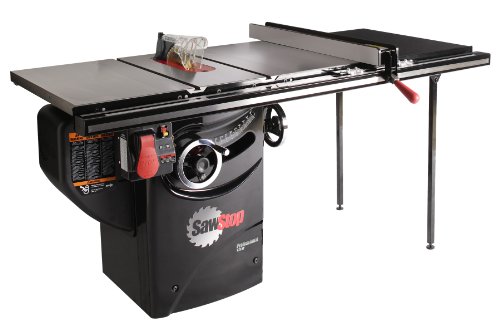
This shortlist is for home-shop woodworkers and small professional shops setting up a fixed cutting station rather than a portable one. Every saw below was picked from its Amazon listing title and specification fields, and each one stays on the list only because its own listing states a dust collection port or dust port diameter in plain wording. Where a listing sells part of the extraction setup separately, that is flagged in the product notes instead of glossed over.
Quick Picks
As an Amazon Associate we earn from qualifying purchases.
| Product | Best for | Key spec from title |
|---|---|---|
| SawStop 10-Inch Professional Cabinet Saw, 3-HP, 52-Inch (PCS31230-TGP252) | Breaking down full plywood sheets day after day | 3-HP motor with 52-inch Professional TGlide fence |
| SawStop 10-Inch Professional Cabinet Saw, 1.75-HP, 36-Inch (PCS175-TGP236) | A serious garage shop on ordinary household power | 1.75-HP motor with 36-inch Professional TGlide fence |
| JET 10-Inch Deluxe XACTA Table Saw, 30-Inch Rip, 3 HP (JTAS-10XL30-DX) | A compact pro corner where 230V is already wired | 3 HP motor with 30-inch XACTA Fence II |
| Powermatic 10-Inch Table Saw, 30-Inch Rip, 5 HP, 3Ph (PM2000B) | A production shop that already has three-phase service | 5 HP motor, 230/460V 3-phase, 30-inch rip |
How to Choose
Match the port diameter to the collector you own
Nearly every cabinet saw in this class vents through a four-inch port at the back of the cabinet, and that single dimension decides how painless setup will be. A four-inch port connects straight to the hose and blast gates of a typical shop dust collector with no adapters. If your extraction is a shop vacuum with a smaller hose, expect to add a reducer and accept weaker capture at the blade, because the shroud around the blade was shaped for collector airflow. Check the listing’s specification table for the exact field, worded as dust collection port diameter, before assuming two saws connect the same way.
Count the airflow the port expects, not just the port
A port is only a hole until air moves through it. SawStop’s guidance for its Professional Cabinet Saw calls for a dust collection system providing at least 350 CFM of flow at the dust port, and JET publishes a 350 CFM minimum for the Deluxe XACTA line. That rules out most small vacuums as the main extractor, however well they work for sanders and routers. If your collector is a single-stage unit at the far end of a long duct run, place the saw on the shortest branch you can, keep flex hose sections brief, and treat the stated minimum as a floor rather than a target.
Work out the electrical supply before the saw is delivered
Cabinet saws split sharply on power, and the listing title tells you which camp each model sits in. The 1.75 HP SawStop configuration is the friendly one for a house, while the 3 HP JET asks for 230V single-phase and the Powermatic PM2000B listed here wants 230/460V three-phase, which most homes simply do not have. A three-phase saw bought for a residential garage turns into a phase converter project or a return. Read the voltage and phase in the title and model number first, then look at your panel, then order.
Treat above-table collection as a separate purchase decision
The cabinet port only handles what falls below the table. What sprays off the top of the blade depends on the guard setup, and listings differ quietly here. On the 3 HP SawStop below, a dust collection blade guard is part of the included components, while on the 1.75 HP configuration that guard is an accessory sold separately, and SawStop’s overarm dust collection is a further add-on for both. JET takes a different route with a completely shrouded blade feeding its built-in port. Decide which of those arrangements you are actually getting, because retrofitting above-table capture later costs more than choosing it now.
The 4 Best Options
SawStop 10-Inch Professional Cabinet Saw, 3-HP, 52-Inch Professional TGlide Fence System (PCS31230-TGP252)
This is the configuration aimed at a shop that rips sheet goods constantly and wants the widest fence reach on the list. The 52-inch TGlide fence gives full support when a plywood sheet overhangs the right side of the blade, and the 3 HP motor keeps feed rates steady in thick hardwood. Its listing is also the most explicit about extraction of any saw here: the specification table names a dust collection port diameter, and the included components list a dust collection blade guard, so both below-table and above-table capture are addressed in the box. Buyers who cut cabinet parts to a schedule, rather than as a weekend project, will feel the difference in the fence first.
Specs
- Blade: 10-inch, with a 40-tooth blade in the included components
- Motor: 3 HP
- Fence: 52-inch Professional TGlide fence system
- Dust Collection Port Diameter: 4 inches, as stated in the listing specification table
- Included components from the listing: cast iron extension wings, miter gauge, dust collection blade guard, riving knife, push stick
- Model number: PCS31230TGP252
Best for: A dedicated shop ripping full sheets and thick stock on a daily cycle.
Watch out for: The overarm dust collection accessory (model TSA-ODC in the listing copy) is sold separately, so full above-table routing is an extra purchase.
ASIN: B005HPWE5W
SawStop 10-Inch Professional Cabinet Saw, 1.75-HP, 36-Inch Professional TGlide Fence System (PCS175-TGP236)
For a one-person garage shop, this is the SawStop layout that avoids rewiring the building. The 1.75 HP motor suits furniture-scale work in hardwood and sheet stock, and the 36-inch TGlide fence still covers the rip width most cabinet carcasses need. Dust handling follows the same pattern as its bigger sibling: a shroud around the blade feeds a four-inch port at the back of the cabinet, sized for a proper collector rather than a vacuum. It suits a buyer who wants the cabinet-saw format, the flat cast iron top and the brand’s blade brake system, but whose work rarely involves resaw-thick rips in dense timber.
Specs
- Blade: 10-inch
- Motor: 1.75 HP
- Fence: 36-inch Professional TGlide fence system
- Dust port: 4-inch port at the back of the cabinet
- Blade guard: micro blade guard on the 1.75 HP configuration
- Riving knife included
- Model number: PCS175TGP236
Best for: A garage or basement shop that needs cabinet-saw accuracy without new wiring.
Watch out for: The dust collection blade guard is an available accessory sold separately on this configuration, so above-table capture is not in the box.
ASIN: B009C7NF0Y
JET 10-Inch Deluxe XACTA Table Saw, 30-Inch Rip, 3 HP, 230V 1Ph (JTAS-10XL30-DX)

JET’s Deluxe XACTA takes the shortest fence on this list and pairs it with the most self-contained dust story. The listing copy describes a completely shrouded blade and a built-in four-inch port for dust collection, with a hinged motor cover on the cabinet for access to the motor and belts. The 30-inch XACTA Fence II keeps the footprint tighter than the wide-fence saws, which matters in a shop where the saw shares floor space with a bench and an assembly table. A quick-release riving knife and an integrated arbor lock round out a machine aimed at steady daily use rather than maximum rip width.
Specs
- Blade: 10-inch
- Motor: 3 HP, 230V 1-phase
- Rip capacity: 30-inch, with XACTA Fence II
- Dust collection: built-in four-inch port, with a completely shrouded blade, per the listing copy
- Drive: upgraded Poly-V belt system
- Part number: 708674PK; model number JTAS-10XL30-1DX
Best for: A small professional shop with 230V power that values a tidy footprint over fence reach.
Watch out for: The listing notes that the dado insert and saw blades are not included and are sold separately, so budget for a blade from day one.
ASIN: B000WO8CA4
Powermatic 10-Inch Table Saw, Extension Table, 30-Inch Rip, 5 HP, 230/460V 3Ph (Model PM2000B)

The PM2000B is the heavy-industry entry here, built around a 5 HP motor and the kind of mass that shrugs off continuous ripping shifts. Powermatic’s listing copy highlights an improved built-in dust collection port with convenient access to the inside of the saw cabinet for clean-up, a practical detail on a machine that will swallow a lot of material in a week. The manufacturer’s specification sheet classifies the style as Cabinet and lists a four-inch dust port outside diameter. This is a saw for a business address with the electrical service to match, not a machine to squeeze into a suburban garage.
Specs
- Blade: 10-inch
- Motor: 5 HP, 230/460V 3-phase
- Rip capacity: 30-inch, with extension table
- Dust collection: improved built-in dust collection port, per the listing copy
- Dust port outside diameter: 4 inches, per the manufacturer specification sheet
- Style (Type): Cabinet
- Model number: PM2000B
Best for: A production or school shop with three-phase power and all-day cutting volume.
Watch out for: Three-phase supply is a hard requirement on this configuration; a home shop without it cannot simply plug this saw in.
ASIN: B07CVYZ6TH
Which One Fits Your Situation
Your shop breaks down plywood every week
Choose the 3 HP SawStop with the 52-inch fence. Sheet work is where fence reach stops being a luxury: the extra rail length supports a full sheet through the cut instead of letting it sag and wander. The included dust collection blade guard also matters here, because sheet goods generate the fine, airborne fraction that a cabinet port alone never sees. The other saws can rip plywood, but you will feel the missing width on every panel.
Your garage still runs on household circuits
Take the 1.75 HP SawStop. It is the only configuration on this list that fits a home shop’s electrical reality without a panel project, and its 36-inch fence still covers standard cabinet carcass widths. Plan the collector purchase alongside it, since the four-inch port wants real airflow, and add the dust collection blade guard later if above-table dust becomes the complaint. Everything else here asks for 230V at minimum.
You have 230V wired and limited floor space
The JET Deluxe XACTA with the 30-inch fence is the balanced pick. Its shrouded blade and built-in four-inch port give the neatest extraction arrangement relative to its size, and the shorter rails leave room to walk around the saw in a tight shop. Accept the trade honestly: crosscutting wide panels will need support stands and more setup than the wide-fence SawStop demands.
Your building already has three-phase power
The Powermatic PM2000B earns its place when the service exists to feed it. Five horsepower and a heavy cabinet suit continuous work, and the built-in port with cabinet access keeps clean-out quick between jobs. If your shop is a school, a rental production space or a farm workshop with three-phase already on the wall, this is the one configuration here that will not need an electrical workaround.
Common Mistakes
- Connecting a four-inch cabinet port to a small shop vacuum with a reducer and expecting real capture at the blade.
- Ordering a 230V or three-phase saw before checking what the building’s panel actually supplies.
- Assuming the dust collection blade guard is included on every configuration, when some listings sell it separately.
- Laying out the shop without a hose route to the port at the back of the cabinet, then strangling airflow with a long, sagging flex hose.
- Comparing fence numbers without checking whether the measurement is rip capacity right of the blade.
Frequently Asked Questions
Will a shop vacuum run the dust port on a cabinet saw?
Poorly, at best. Cabinet saws on this list use four-inch ports shaped around collector airflow, and published guidance for these models sets a minimum around 350 CFM at the port. A vacuum moves far less air through a smaller hose, so it can help with clean-up around the saw but will leave the blade shroud underfed during cuts. A small single-stage collector is the realistic starting point.
Where does the dust port sit, and why does it matter?
On these saws the port is at the back of the cabinet, fed by a hose from the shroud around the blade. Placement matters because the run from port to collector should stay short and straight; every extra metre of flex hose and every tight bend costs airflow. When you lay out the shop, give the saw a position where the collector or a duct branch can reach that rear port without crossing walkways.
Is above-table dust collection included with these saws?
It depends on the configuration, which is why the listings need reading line by line. The 3 HP SawStop above lists a dust collection blade guard among its included components, while the 1.75 HP version treats that guard as a separate accessory, and the overarm collection unit is separate again. JET instead shrouds the blade completely and routes debris to its built-in port. Never assume the guard in a photo is the guard in the box.
Can a cabinet saw be moved once it is installed?
Yes, but plan for weight rather than improvising. These are cast iron machines of several hundred pounds, and none of the listings here presents mobility as a feature. An optional mobile base is the usual answer for a shop that rearranges seasonally. If the saw must roll daily to free up floor space, a cabinet saw is the wrong format and a smaller saw on a stand will serve you better.
More from Amazon
Programs that pair well with the guide above. Offers and eligibility are set by Amazon and may change.
Free shipping on eligible items, Prime Video and more. Eligible new members can start with a free trial.
Start a Prime free trialAudiobooks and podcasts to listen to on the go. Eligible new members can start with a free trial.
Try Audible freeAd-free music streaming. Eligible new subscribers can start with a free trial.
Try Music Unlimited freeA free business account with business pricing and bulk-buying tools for work, shop or home office.
Create a business accountAs an Amazon Associate we earn from qualifying purchases.





Write Your Review
No reviews yet. Be the first to share your experience!