

Our Short List of 3
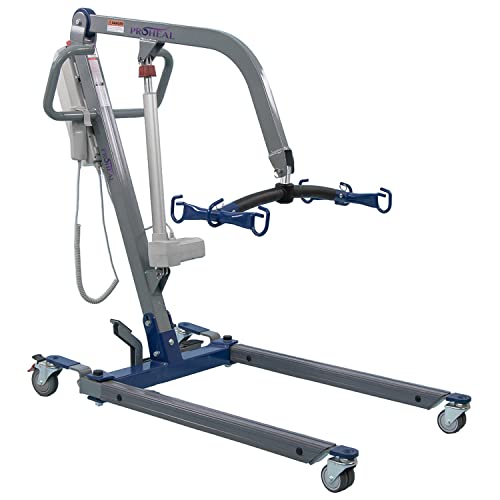
- Type: Electric full-body patient lift
- Capacity stated: 500 lb
- Spreader bar: 6-point
- Base: Adjustable locking base, opened with a foot pedal

- Type: Electric patient lift with sling
- Capacity stated: 400 lb maximum weight recommendation
- Frame: Alloy steel, grey
- Model number stated: BHH-YWJ-D02A-1
- Type: Electric full-body patient lift, bariatric
- Capacity stated: 600 lb
- Spreader bar: 6-point
- Base: Easily adjustable locking base
All 3 Picks at a Glance
| Product | Specs | Action |
|---|---|---|
| 1. ProHeal Electric Lift — Best All-Round Home and Facility Lift |
| Check price on Amazon |
| 2. Huilink Electric Patient Lift — Best for a Rotating Sling Bar at 400 lb |
| Check price on Amazon |
| 4. ProHeal Bariatric Patient Lift — Best for Higher Capacity |
| Check price on Amazon |
Key takeaways
- Compare electric patient lifts with emergency lowering by capacity, spreader bar, base fit and sling included, for safer bed, chair and floor transfers at home.
An electric patient lift earns its place in a home when two questions have clear answers. First, can the powered actuator raise and lower the person smoothly, so the caregiver guides the lift instead of supplying the lifting force? Second, what happens if power fails partway through a transfer, with the person already raised in the sling? That second question is why emergency lowering matters, and it is the filter for every pick here.
This article covers floor-based electric sling lifts for bed, wheelchair, commode and floor-level transfers in homes and care facilities — not ceiling track systems, sit-to-stand aids, or hydraulic lifts that rely on a hand pump. Every lift below is powered, and every listing states a manual or emergency lowering route for a loss of power. Read that procedure in the manual for the exact model you buy before the first real transfer, because the mechanism differs from lift to lift, and reaching the control calmly is much easier when you have already found it once.
As an Amazon Associate, we earn from qualifying purchases made through links on this page, at no extra cost to you.
Quick Picks
- Best all-round home and facility lift: ProHeal Electric Lift, 500 lb — a six-point spreader bar, a foot-pedal base and manual emergency lowering for power loss.
- Best for a lower stated capacity and a rotating sling bar: Huilink Electric Patient Lift — a 400 lb rating, an adjustable base, a 360-degree rotatable sling bar and emergency manual descent.
- Best for a commode sling in the box: MediHoist Electric Patient Lift — a 500 lb rating, a commode sling included, a rotating sling bar and an emergency manual lowering system.
- Best for higher capacity: ProHeal Bariatric Patient Lift, 600 lb — a six-point spreader bar and the same manual emergency lowering approach, in a frame that is not foldable for car use.
| Lift | Capacity stated | Spreader bar | Emergency lowering stated | Sling note |
|---|---|---|---|---|
| ProHeal Electric Lift | 500 lb | 6-point | Manual emergency lowering | Compatible with a variety of slings; check the listing for what is included |
| Huilink Electric Patient Lift | 400 lb | 360-degree rotatable | Emergency manual descent | Sold with a sling in the listing title |
| MediHoist Electric Patient Lift | 500 lb | 360-degree rotating | Emergency manual lowering system | Commode sling included |
| ProHeal Bariatric Patient Lift | 600 lb | 6-point | Manual emergency lowering | Compatible with a variety of slings; check the listing for what is included |
1. ProHeal Electric Lift — Best All-Round Home and Facility Lift
- Type: Electric full-body patient lift
- Capacity stated: 500 lb
- Spreader bar: 6-point
- Base: Adjustable locking base, opened with a foot pedal
The ProHeal Electric Lift is the straightforward answer for a household or facility that wants one powered full-body lift for the usual transfers: floor to bed, bed to wheelchair, chair to commode, and back again. The listing describes one-touch electric lifting and lowering, so the caregiver’s hands stay free for guiding rather than working a pump handle.
Capacity is stated at 500 lb, and the six-point spreader bar widens its usefulness. Six attachment points let you position a compatible sling in more ways than a two-point bar — more reclined for a floor pickup, more upright for a commode transfer. The listing states the bar works with a variety of ProHeal and other-brand slings, but match the sling’s attachment style and size to the person and the bar before ordering.
The base opens with a foot pedal, leaving both hands on the push handles while you widen the legs around a wheelchair. Dual rear locking casters help hold the lift in place, and clip-free sling hookups make attaching the sling less fiddly. On this guide’s safety filter, the listing is explicit: in case of power loss, there is manual emergency lowering — the correct backup for a battery lift, because it does not depend on the battery that has just failed. Practise the sequence with an empty sling so the first use is not during a real outage.
Specifications
Pros
Cons
View the ProHeal Electric Lift on Amazon
2. Huilink Electric Patient Lift — Best for a Rotating Sling Bar at 400 lb
- Type: Electric patient lift with sling
- Capacity stated: 400 lb maximum weight recommendation
- Frame: Alloy steel, grey
- Model number stated: BHH-YWJ-D02A-1
The Huilink Electric Patient Lift suits a home where 400 lb of stated capacity is enough and the transfer route runs between a low bed, a chair and the floor. Its listing describes an electric lift sold with a sling, making it a self-contained starting point for a household that does not already own a compatible sling.
Its separating feature is the 360-degree rotatable sling bar. Once the person is raised clear, a rotating bar lets the caregiver turn them in the sling to face the destination, instead of dragging the whole lift in an arc — a real help in a small bedroom where the lift may only approach the bed from one side.
The listing gives a grey alloy steel frame, dimensions of 24 by 42 by 36 inches, an item weight of 90 lb, and model number BHH-YWJ-D02A-1. An adjustable base helps the legs straddle a wheelchair, and a rear locking caster helps keep the lift from rolling during positioning. For emergency lowering, the product description names an emergency manual descent feature. Treat that as a prompt to read the exact instructions for this model and to clear the area below the sling before you start a descent.
Specifications
Pros
Cons
View the Huilink Electric Patient Lift on Amazon
3. MediHoist Electric Patient Lift — Best for a Commode Sling in the Box
The MediHoist Electric Patient Lift suits caregivers who want the toileting transfer covered from day one, because the listing includes a commode sling. A standard full-body sling can make a commode transfer clumsy, while a commode sling is shaped to give access once the person is positioned, so including one removes a separate purchase and compatibility check.
Stated capacity is 500 lb. The listing describes a motor with an output of 8000N, a 360-degree rotating sling bar, and 80 to 120 lifts per charge, depending on weight and temperature. Treat that range as a planning figure, not a promise: heavier loads and cold rooms sit at the harder end of any battery’s work, so build a charging routine around the transfers you actually make each day.
The emergency provision comes in two parts. An emergency stop halts the motor during an unexpected situation, and an emergency manual lowering system lowers the person safely during a power failure or technical issue. Those are different tools: the stop pauses a transfer that does not look right, while manual lowering finishes a transfer when the powered system will not. Know both controls, and the manufacturer’s instruction for resetting the lift after the stop has been used. The frame is described as foldable, which is a storage bonus here rather than the reason to buy it.
Specifications
- Type: Electric patient lift
- Capacity stated: 500 lb
- Motor output stated: 8000N
- Lifts per charge stated: 80 to 120, depending on weight and temperature
- Sling bar: 360-degree rotating
- Included sling: Commode sling
- Emergency features stated: Emergency stop and emergency manual lowering system
Pros
- Commode sling included, which simplifies toileting transfers
- Rotating sling bar helps with positioning over a bed, chair or commode
- Both an emergency stop and a manual lowering system are stated
- A stated lifts-per-charge range helps you plan a charging routine
Cons
- Battery performance varies with load and temperature, so the top of the stated range will not suit every home
- A commode sling is a specialised shape and may not be the only sling a household needs
- The folding design still leaves a heavy lift to move when it is folded
View the MediHoist Electric Patient Lift on Amazon
4. ProHeal Bariatric Patient Lift — Best for Higher Capacity
- Type: Electric full-body patient lift, bariatric
- Capacity stated: 600 lb
- Spreader bar: 6-point
- Base: Easily adjustable locking base
Some households should start from capacity and work backwards, and that is where the ProHeal Bariatric Patient Lift belongs. Its stated capacity is 600 lb, the highest in this guide, and the listing describes full-body transfers from the floor, a low bed and a chair for home use and facilities.
It uses a six-point spreader bar with the same broad sling compatibility as the 500 lb ProHeal model. At this capacity, sling choice is not a detail to leave to chance: the sling must be rated for the person’s weight, sized correctly, and inspected for worn straps and stitching, because the lift’s rating only helps if every part of the lifting chain shares it.
The safety description follows the same pattern: clip-free hookups, dual rear locking casters, an easily adjustable locking base, and manual emergency lowering in case of power loss. That last point matters most at higher loads — the procedure must be carried out slowly, exactly as directed, into a clear space. One limit is stated plainly in answers about this model: it is not foldable to place in a car. This is a lift for working in place, bought with its room, doorways and turning space already measured.
Specifications
Pros
Cons
View the ProHeal Bariatric Patient Lift on Amazon
How to Choose an Electric Patient Lift With Emergency Lowering
Start with the emergency lowering method, not the headline. Ask how the person comes down when the battery is flat, the hand control fails, or the power cuts out. A manual release, crank or descent control that works without electrical power is the strongest answer, because it does not depend on the system that just failed. Then find that control in the manual for the exact model, and make sure the caregiver who will use it can reach it while standing in a safe position beside the lift.
Match capacity to the person, with room to spare. Use the person’s current weight, with clothing and any equipment worn in the sling, and choose a lift rated above it. The sling has its own rating too, and the lowest rating in the chain is the real limit.
Measure the room before you measure the lift. Check the clearance under the bed, the width the base opens to, whether it can straddle your wheelchair or commode, doorway widths on the route, and turning space at the bed. A lift whose legs cannot slide under the bed cannot do the transfer, whatever its capacity says.
Decide which sling you need first. A full-body sling suits complete support, a commode sling suits toileting, and a divided-leg sling can be easier to fit under someone seated. If a lift is sold with a sling, confirm its size against the manufacturer’s chart rather than assuming it fits everyone.
Plan the power routine. Battery lifts need a charging habit: where the charger lives, how long a charge takes, and how you will know the battery is low. Either way, emergency lowering is your backup when the plan fails, so practise it rather than just reading it once.
Think about who is doing the guiding. Electric lifting removes the pumping effort, but the caregiver still pushes and steers the loaded lift and positions the person — real work on carpet, over thresholds and in tight bathrooms. If one caregiver works alone, favour a base that opens without bending, casters that lock clearly, and a sling bar that rotates.
Frequently Asked Questions
What is emergency lowering on an electric patient lift?
It is a backup way to bring the person back down when the powered system cannot, for example after a power loss or control failure. On the lifts in this guide it is described as a manual lowering system or an emergency manual descent, meaning the caregiver operates a mechanical control rather than relying on the battery or motor.
Is an emergency stop button the same as emergency lowering?
No. An emergency stop halts the motor and holds the lift where it is. Emergency lowering is what gets the person down from that held position. A lift can have one without the other, so check for both, and check that the lowering method works without electrical power if that is the failure you are planning for.
Can these lifts pick someone up from the floor?
The ProHeal models are described for floor, low bed and chair lifting, and floor-level recovery is a stated use for the other picks as well. Whether a transfer works depends on how low the boom and sling can go, the sling used, and the space around the person. Practise the setup before you need it after a real fall, and follow local guidance on when a fall needs medical assessment first.
How do I know which sling fits?
Use the sling manufacturer’s sizing chart, based on height, weight and body shape, and confirm the attachment style matches the spreader bar. The sling must also be rated for the person’s weight. If the person slides, tips or feels pressure at the edges, stop and reassess size and type.
Does the lift or the sling decide the real weight limit?
Both do, along with the spreader bar. The safe limit for a transfer is the lowest rating among the parts carrying the load. A 600 lb lift paired with a sling rated lower than the person’s weight is not a 600 lb system for that person.
What should I check before every transfer?
Confirm the battery charge, check that the base opens and locks and the rear casters lock and release, inspect the sling and straps for damage, and confirm the emergency lowering control is reachable. Make sure the destination is in place with its brakes set before you lower.
Conclusion
For most homes, the ProHeal Electric Lift at 500 lb is the balanced choice: a six-point bar, a foot-pedal base and manual emergency lowering. Choose the Huilink lift if 400 lb is enough and a rotating bar would ease tight-room positioning. Choose the MediHoist lift if a commode sling in the box solves your most frequent transfer. Choose the ProHeal Bariatric lift if capacity decides it and the lift will work in one place.
Whichever model you choose, treat emergency lowering as a skill, not a specification. Read the procedure for your exact lift, practise it with an empty sling, and keep the area below the sling clear. The powered lift does the heavy work; the backup lowering system makes a bad moment manageable instead of frightening.
More from Amazon
Programs that pair well with the guide above. Offers and eligibility are set by Amazon and may change.
Free shipping on eligible items, Prime Video and more. Eligible new members can start with a free trial.
Start a Prime free trialAudiobooks and podcasts to listen to on the go. Eligible new members can start with a free trial.
Try Audible freeAd-free music streaming. Eligible new subscribers can start with a free trial.
Try Music Unlimited freeA free business account with business pricing and bulk-buying tools for work, shop or home office.
Create a business accountAs an Amazon Associate we earn from qualifying purchases.



Write Your Review
No reviews yet. Be the first to share your experience!