

Key takeaways
- Find the leading ceiling track patient lift with compatible slings, comparing weight capacity, track layout, sling fit and controls for safer home transfers.
Choosing a ceiling track patient lift is really a decision about the room, the person being moved, and the caregiver doing the moving. A track or gantry layout decides where a transfer can start and end, while the lift motor, the carry bar, and the sling must all agree on capacity and attachment style. When any one of those parts does not match the others, the result is a system that cannot be used as intended, however strong the motor looks on its own.
This guide is written for family caregivers setting up a home bedroom, home-care aides who run several transfers a day, and facility buyers fitting out a single room without structural work. The pick below comes from the name and specifications stated on its Amazon product page, with attention to lifting capacity, track or gantry layout, sling compatibility, and the controls a caregiver uses during every transfer. Checking those four points prevents most buying mistakes.
Quick Picks
As an Amazon Associate we earn from qualifying purchases.
| Product | Best for | Key spec from title |
|---|---|---|
| Platinum Health Elevate 440 Professional Overhead Patient Lift System | Bed-to-chair transfers in a room where ceiling work is not an option | 440 lb lifting capacity with freestanding gantry |
How to Choose
Weight capacity and the lowest-rated part
Start with the weight of the person who will use the lift, then add clothing, bedding, and any support the sling carries, and compare that total with the safe working load of every part of the system. The motor, the carry bar, the track or gantry, and the sling each carry a rating, and the lowest of those ratings sets the real limit for the whole setup. A sling rated below the motor does not become stronger because the motor is powerful. Check the rating printed on the sling label itself, keep a margin below the stated maximum, and recheck it regularly, and confirm the figure with the supplier when the person being moved is close to a capacity boundary.
Track layout and room coverage
A ceiling track lift only helps where its track actually runs, so map the full transfer path before ordering anything. Measure from the bed to the chair, the commode, and the bathing area, and note doorways, ceiling fans, light fixtures, and sloped ceilings that could interrupt the run. Fixed tracks suit a permanent bedroom layout, while a freestanding gantry suits a room where drilling into joists is not possible or not wanted. Confirm the assembled footprint, the height under the track, and whether the system can be moved or extended later, because a lift that stops short of the chair leaves the hardest part of the transfer unsolved, so measure twice. Note the hand controller position during each transfer.
Sling fit and attachment style
Slings are not interchangeable by appearance alone, and fit matters as much as fabric. Measure hip width, trunk length, and head support needs, then match those measurements to the sling size chart for the exact model being bought. Loop slings and clip slings attach differently, so the sling must match the carry bar on the lift motor, and the attachment points must sit evenly on both sides before any lift begins. Mesh suits bathing and drying, while padded fabric suits longer seated transfers. Keep at least one spare sling in the correct size, and replace any sling that shows fraying, stretched stitching, or faded capacity labels. An oversized sling allows sliding, while an undersized sling presses uncomfortably during the lift.
Controls, power and everyday handling
A lift used several times a day should be operable by one caregiver without awkward reaching or heavy effort. Look for a hand controller with clearly separated raise and lower buttons, plus an on-board control on the motor unit as a backup. Battery-powered motors need a charging routine, so ask how many transfers a charge supports and where the charger lives when the lift is idle. Emergency lowering matters when power runs out mid-transfer, so confirm how it works before the first real use. Quiet, smooth starting and stopping also matters, because sudden movement unsettles the person in the sling and makes positioning harder. Test the emergency lowering and the charging routine during setup, not during the first real transfer.
The 1 Best Option
Platinum Health Elevate 440 Professional Overhead Patient Lift System
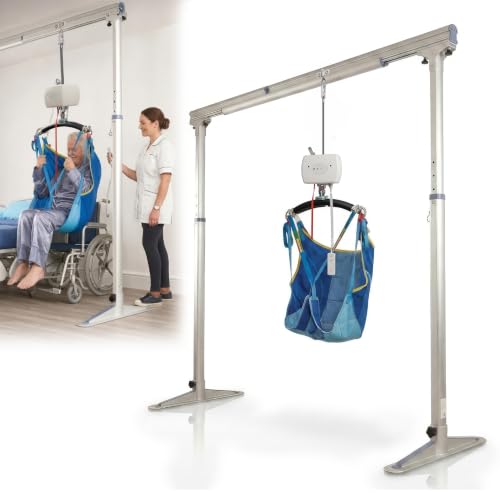
The Elevate 440 is a hospital-graded overhead patient lift built around a freestanding gantry, which makes it a practical answer for a home bedroom where a fixed ceiling track cannot be installed. Its electric push-button operation keeps transfers smooth for one caregiver, and the rechargeable battery motor runs quietly enough for early-morning or late-evening moves. Because the gantry sets up without tools and needs no fasteners into the floor or ceiling, the system can be placed over the bed, taken apart, and stored or moved to another room when care needs change. The wide sling range covers full-body support, toileting, and repositioning, so one motor serves several routines.
Specs
- 440 lb lifting capacity
- Electric, push-button operation
- Freestanding gantry with tool-less setup
- Rechargeable battery-powered lifting motor
- Hand controller and on-board touch pad
- Hospital-graded overhead lift design
- Lightweight yet robust gantry frame
- Wide range of slings available for different care tasks
- Suited to bed-to-chair and chair-to-bed transfers, in-bed repositioning, toileting, personal hygiene and wound care
Best for: Home bedrooms where a fixed ceiling track cannot be installed and one caregiver handles regular bed-to-chair transfers.
Watch out for: Confirm the assembled gantry footprint fits the room with space to walk around the bed, and check that the sling style and attachment points match the carry bar before ordering, since slings are chosen separately for the task at hand.
Which One Fits Your Situation
A bedroom where ceiling work is not allowed
Choose the Platinum Health Elevate 440, because its freestanding gantry brings overhead lifting into a rented home or a room where drilling into joists is not permitted. The system stands over the bed without fasteners, so the room itself stays unchanged. Measure the floor space first, keep the path beside the bed clear, and the lift can serve daily transfers reliably without any building work at all. Clear bedside tables and rugs from the gantry footprint before the first transfer.
Frequent daily transfers by one caregiver
Choose the Platinum Health Elevate 440, because push-button electric operation and a hand controller let a single caregiver raise and lower the person in the sling without manual cranking or heavy pulling. Smooth starting and stopping keeps the person settled during the move, and the on-board touch pad gives a second way to control the motor when the hand controller is out of reach. Charge the battery every evening so the motor is ready for the morning round of transfers.
A heavier user close to standard capacity limits
Choose the Platinum Health Elevate 440, because its 440 lb capacity covers many adults who sit above the range of lighter portable lifts, provided the sling chosen carries a matching rating. Check the sling label, confirm the carry bar rating, and treat the lowest figure in the chain as the working limit. Keep the sling size chart nearby for every caregiver. When the person is near that limit, ask the care team to confirm the setup before routine use begins.
A temporary setup that may move rooms
Choose the Platinum Health Elevate 440, because the tool-less gantry comes apart for storage and can be reassembled in another room or another home. That flexibility suits short-term recovery, a trial period before a permanent track is fitted, or a household where the care room changes. Keep the assembly steps and the charger together with the unit so every move goes smoothly. A trial period shows whether the gantry footprint suits the room before any permanent track is considered.
Common Mistakes
- Buying a lift motor without checking that the sling attachment style matches the carry bar, then discovering the sling cannot be fitted safely, and the mismatch only shows up at first use.
- Treating the motor capacity as the system capacity, while the sling or the track carries a lower rating that becomes the real limit, so write every rating down before ordering.
- Ordering a sling by clothing size instead of the hip, trunk and head measurements on the sling size chart, which leads to poor support and an uneven lift, and check the fit again after any change in weight.
- Planning the track or gantry around the bed alone and forgetting the chair, commode and bathing area that complete the daily transfer route, then discovering the lift stops short of the chair.
- Skipping a practice run with the emergency lowering function and the charging routine, so the first power problem happens during a real transfer instead of a rehearsal, and rehearse the route from bed to chair first.
Frequently Asked Questions
Does a ceiling track patient lift need a fixed track installed in the ceiling?
Not always, and the answer depends on the system chosen. Fixed tracks are mounted to ceiling joists and suit a permanent bedroom layout, while freestanding gantry systems carry their own overhead rail and need no drilling or fasteners. A freestanding system works well in rented homes and temporary setups, though it takes up floor space around the bed. Confirm the layout, the footprint, and the transfer path before ordering.
How do I know which sling fits the person using the lift?
Use the sling size chart for the exact sling model, measuring hip width, trunk length, and head support needs. The sling must also match the carry bar attachment style, whether loops or clips, and its rated capacity must meet or exceed the weight being lifted. When measurements fall between two sizes, or the person has limited trunk control, ask the care team or supplier for guidance before ordering.
What weight capacity should a home ceiling lift have?
Choose a system whose lowest-rated part still sits comfortably above the full weight being lifted. A 440 lb capacity suits many home users, but the sling, carry bar and gantry each carry their own rating, and the lowest of them governs the setup. When the person is close to a limit, confirm the figures with the supplier and the care team rather than assuming a margin exists.
Can one caregiver operate a ceiling track patient lift alone?
Many electric overhead lifts are designed for single-caregiver use, with a hand controller for raising and lowering and an on-board control as a backup. Even so, a second person should be present for the first transfers, until the caregiver is confident with sling fitting, positioning, and emergency lowering. Follow the instructions supplied with the lift, keep the battery charged, and never leave the person unattended while suspended in the sling.
More from Amazon
Programs that pair well with the guide above. Offers and eligibility are set by Amazon and may change.
Free shipping on eligible items, Prime Video and more. Eligible new members can start with a free trial.
Start a Prime free trialAudiobooks and podcasts to listen to on the go. Eligible new members can start with a free trial.
Try Audible freeAd-free music streaming. Eligible new subscribers can start with a free trial.
Try Music Unlimited freeA free business account with business pricing and bulk-buying tools for work, shop or home office.
Create a business accountAs an Amazon Associate we earn from qualifying purchases.



Write Your Review
No reviews yet. Be the first to share your experience!