

Key takeaways
- Compare compact superautomatic espresso machines with saved user profiles from DeLonghi, Gaggia and Philips by footprint, pump pressure, tank and milk system.
As an Amazon Associate, we earn from qualifying purchases made through links on this page.

A superautomatic espresso machine grinds the beans, tamps, brews and handles milk on its own, so a drink that would take a row of separate tools on a manual setup comes from one box on the counter. The catch for shared households is that one box usually remembers one set of preferences. If two or three people each want a different strength, a different cup volume and a different amount of milk, a machine without saved profiles makes somebody redo those settings every single morning.
This guide only includes compact superautomatic machines that store named user profiles, verified against each maker’s own documentation. Every model below grinds and brews automatically, has a manufacturer-documented milk system, saves drink settings under separate user profiles, and keeps a footprint at or near ten inches of width. Dimensions, pump pressure, water tank capacity and profile counts are the figures each manufacturer publishes for the exact model named.
Three machines passed both tests. They differ in how many profiles they hold, how the milk system works, and how the tank and grounds container are reached, and those differences matter more in a small kitchen than the length of the drink menu.
What to look for
User profiles that store the whole drink
A profile is only useful if it stores the complete recipe, not just one setting. Check what each profile holds: coffee strength, coffee volume, milk volume and temperature are the fields that decide whether your saved cappuccino comes back the way you set it. Also check the profile count against the household. Two profiles suit a couple; three or four cover a family or a shared flat. A guest profile is a bonus, since visitors can adjust a drink without overwriting anyone’s saved version.
A footprint you measure in three directions
Compact has no single industry definition, so compare the published width, height and depth of each model against your counter. Width decides whether the machine fits between other appliances. Height decides whether it slides under wall cabinets, and depth decides how much counter remains in front of it. Then check how the water tank comes out. A front-access tank can be refilled with the machine pushed back under a cabinet; a top or side tank needs clearance every time you fill it.
The milk system you will actually clean
Each maker solves milk differently. Philips LatteGo uses a small two-part container with no tubes. De’Longhi LatteCrema and the Gaggia Cadorna carafe use a sealed jug that can go back into the refrigerator between drinks. All three approaches froth automatically, but the number of parts you rinse after a cappuccino differs, and that daily chore is the one that decides whether a machine stays pleasant to own.
Pump pressure, tank size and grinder, as published
Manufacturers publish pump pressure in bar, and the three machines here sit at 15 or 19 bar. Treat the figure as a spec to compare on paper rather than a promise about the cup. Tank capacity is easier to judge: 1.5 to 1.8 litres is the range in this guide, and a smaller tank on a front-access design may be refilled more often but with less effort. Grinder material and the number of grind settings are also published for each model, ceramic on the Philips and Gaggia machines and stainless steel on the De’Longhi.
Cleaning access
A removable brew group can be rinsed under a tap, and all three makers here use one. Check the grounds container capacity as well, because a compact body usually means a smaller container and more frequent emptying. Water filter systems such as Philips AquaClean or the Gaggia Mavea Intenza change how often descaling is needed, according to each maker’s documentation.
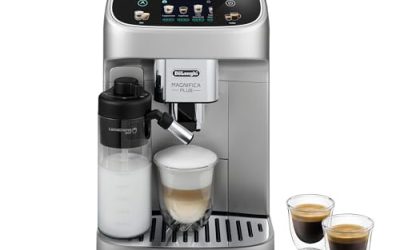
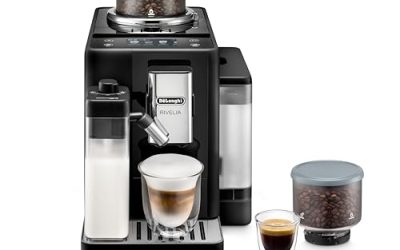
De’Longhi Dinamica Plus (ECAM37095TI)
The Dinamica Plus is the most connected machine in this guide. De’Longhi builds it around a 3.5-inch color touch display and the Coffee Link app, and the profile system works through both: the maker documents three user profiles, and the app lets each profile hold personalized recipes that can be sent to the machine. Its Smart One-Touch function also learns which drinks each person picks most and moves those to the front of the display.
By the numbers from De’Longhi, the machine measures 9.3 inches wide, 16.9 inches deep and 13.7 inches high, the narrowest and lowest body in this guide. The pump is documented at 19 bar, the water tank holds 1.8 litres, the bean container holds 300 grams, and the grounds container takes about 14 servings. The stainless steel conical burr grinder has 13 settings, and the drink list runs to 16 barista-style beverages on the display, including an over-ice recipe that brews at a lower temperature for iced coffee.
Milk comes from the LatteCrema Hot carafe, which textures milk automatically and can be stored in the refrigerator between uses. The carafe, drip tray parts and the removable brew unit are documented as dishwasher safe or rinse-clean by the maker, which keeps the daily routine short.
This machine fits a household of up to three regular drinkers who want app control and the widest drink list in the smallest body here. Its limits follow from the spec sheet: three profiles is one fewer than the Gaggia below, the tank is reached from the front but the machine still needs top access to fill the bean hopper, and anyone who wants more than three saved identities will outgrow it.
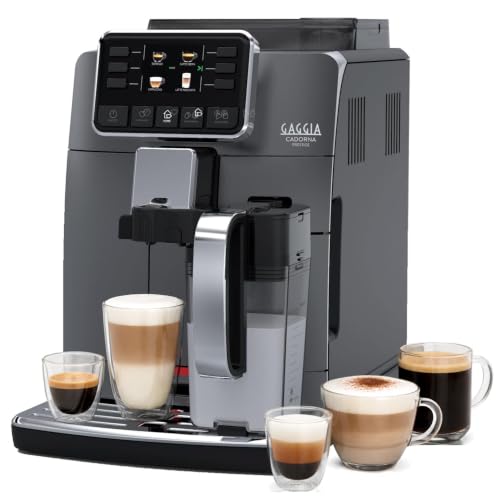
Gaggia Cadorna Prestige (RI9604/47)
The Cadorna Prestige is built in Italy and takes the opposite approach to profiles: no app, no accounts, just four color-coded profiles on the machine itself, shown as colored icons beside the full-color TFT display. Gaggia documents that each of the four profiles can memorize every beverage on the menu personalized to that user, so four people can each keep their own version of all 14 preset drinks.
Gaggia publishes dimensions of 26 cm wide, 38 cm high and 44 cm deep, roughly 10.2 by 15 by 17.3 inches, with a weight of about 9.6 kg. The pump is documented at 15 bar. The water tank holds 1.5 litres and, usefully for a machine that lives under cabinets, it slides out from the front like a drawer; the coffee pucks container, which holds 10 pucks, is also reached from the front. The bean container holds 300 grams, the ceramic grinder has 10 settings, and the integrated milk carafe holds 0.6 litres.
The carafe handles cappuccino and latte macchiato at one touch and runs an automatic rinse cycle after use, per Gaggia’s documentation. The brew group removes for rinsing, and the machine works with the Mavea Intenza water filter.
This is the pick for a household of four where everyone drinks something different and nobody wants an app account standing between them and their saved settings. Its limits are plain from the figures: the 1.5-litre tank is the smallest in this guide, so a busy four-person kitchen refills it more often; the body is the tallest here at 15 inches, which needs checking against low cabinets; and there is no app control at all, so profiles live only on the machine.
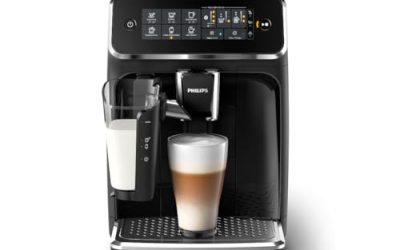
Philips 4300 LatteGo (EP4347/94)

The Philips 4300 LatteGo is the simplest profile machine of the three. Philips documents two user profiles plus an extra guest profile, and each profile stores customized recipes set through the Coffee Customizer on the color display: aroma strength across five settings, coffee and milk length, and temperature across three settings. Eight beverages sit on the menu, covering espresso, coffee, Americano, cappuccino, latte macchiato and café au lait among them.
Philips publishes dimensions of 246 by 371 by 433 mm, roughly 9.7 inches wide, 14.6 inches high and 17 inches deep, and a weight of 8 kg, the lightest machine here. The pump is documented at 15 bar, the water tank holds 1.8 litres with frontal access, the bean container holds 275 grams, and the waste container takes 12 servings. The all-ceramic grinder has 12 settings, and Philips documents it for at least 20,000 cups.
The LatteGo milk system is the cleaning argument for this machine: the milk container has two parts and no tubes, holds 0.26 litres, and Philips documents that it can be rinsed in as little as 15 seconds or placed in the dishwasher. The brew group removes fully for rinsing, and the AquaClean filter is documented to stretch the run to 5,000 cups without descaling when changed as prompted.
This machine fits a couple, or one regular drinker plus occasional guests, who want saved drinks with the least milk-system cleaning in this guide. Its limits are the mirror of its simplicity: two profiles is the fewest here, eight drinks is the shortest menu, and the small 0.26-litre milk container suits one or two milk drinks in a row rather than a round for a group.
Comparison table
| Machine | User profiles | Dimensions (W x H x D) | Pump pressure | Water tank | Milk system | Drinks |
|---|---|---|---|---|---|---|
| De’Longhi Dinamica Plus ECAM37095TI | 3, plus app recipes | 9.3 x 13.7 x 16.9 in | 19 bar | 1.8 L | LatteCrema Hot carafe | 16 on display |
| Gaggia Cadorna Prestige RI9604/47 | 4, color-coded | 10.2 x 15 x 17.3 in | 15 bar | 1.5 L, front drawer | Integrated carafe, 0.6 L | 14 |
| Philips 4300 LatteGo EP4347/94 | 2, plus guest | 9.7 x 14.6 x 17 in | 15 bar | 1.8 L, front access | LatteGo container, 0.26 L | 8 |
Frequently asked questions
What does a user profile actually save on these machines?
On all three, a profile saves your customized version of each drink: strength, coffee volume and, on milk drinks, milk volume. The De’Longhi and Gaggia hold three and four profiles respectively; the Philips holds two plus a guest profile. Temperature is also adjustable per drink on the Philips and Gaggia, per their documentation.
Which of these is the smallest?
By published width and height, the De’Longhi Dinamica Plus is the smallest body here at 9.3 inches wide and 13.7 inches high. The Philips is close behind and the lightest at 8 kg. The Gaggia is the widest and tallest of the three, though its front-loading tank means it needs less clearance above and in front when refilling.
Does a 19 bar pump make better espresso than a 15 bar pump?
Not on its own. Pump pressure is the maximum the pump can produce, as published by the maker, and extraction in the cup depends on grind, dose and the brew group as well. Use the bar figure to compare spec sheets, and weigh profiles, tank access and the milk system more heavily, since those shape daily use.
Can these machines use pre-ground coffee?
Yes. Philips and De’Longhi both document a pre-ground option on these models, useful for an occasional decaf without emptying the bean hopper. The grinder remains the main path, and each maker publishes the scoop and chute arrangement in its manual.
How much upkeep does a superautomatic need?
Plan on emptying the drip tray and grounds container regularly, rinsing the removable brew group under a tap on the maker’s schedule, rinsing the milk system after milk drinks, and descaling when the machine prompts. The Philips pairs that routine with its AquaClean filter, which the maker documents as extending the run between descales when replaced as prompted.
Conclusion
All three machines in this guide grind, brew and froth automatically in a body around ten inches wide, and all three keep each drinker’s settings under a saved profile, which is the combination this keyword asks for. Pick the De’Longhi Dinamica Plus if three profiles, an app and the smallest body fit your kitchen. Pick the Gaggia Cadorna Prestige if four people need profiles and you prefer them on the machine, with a front-loading tank for cabinet-bound counters. Pick the Philips 4300 LatteGo if two profiles are enough and the two-part, tube-free milk container is the cleaning routine you will actually keep up. Measure your counter and cabinet height against the published dimensions before you decide, since the differences between these three are measured in single inches.
More from Amazon
Programs that pair well with the guide above. Offers and eligibility are set by Amazon and may change.
Free shipping on eligible items, Prime Video and more. Eligible new members can start with a free trial.
Start a Prime free trialAudiobooks and podcasts to listen to on the go. Eligible new members can start with a free trial.
Try Audible freeAd-free music streaming. Eligible new subscribers can start with a free trial.
Try Music Unlimited freeA free business account with business pricing and bulk-buying tools for work, shop or home office.
Create a business accountAs an Amazon Associate we earn from qualifying purchases.
Write Your Review
No reviews yet. Be the first to share your experience!